


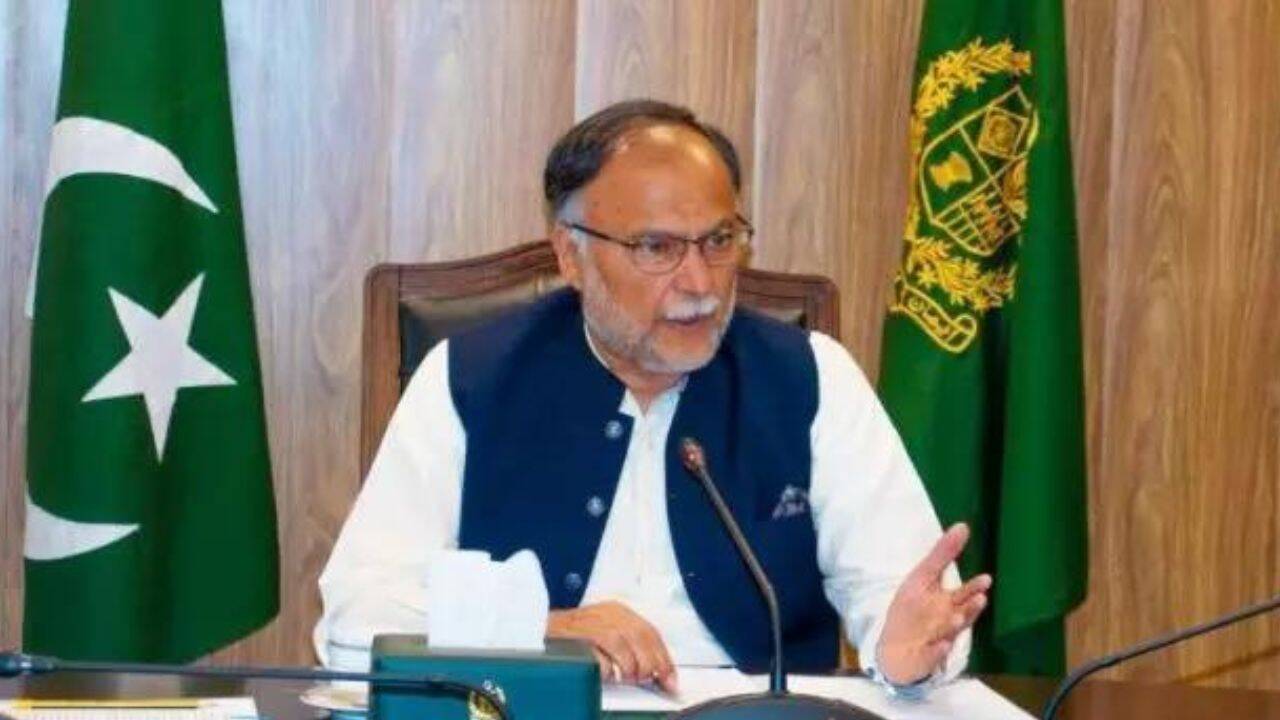
'India could use water as weapon': Pak minister as IWT remains in abeyance
Summarized and contextualized by DistantNews.
At a glance
News
Named sources
New plan
- A Pakistani minister claims India could "weaponize" the Indus Water Treaty (IWT), which has been in abeyance.
- The minister expressed concern that India might use water as a tool to deny Pakistan essential resources.
- Pakistan's Prime Minister had previously warned of a "direct response" if India does not reconsider its actions regarding the treaty.
Pakistan's Minister Ahsan Iqbal has voiced serious concerns that India might "weaponize" the Indus Water Treaty (IWT), a landmark agreement that has historically remained untouched between the two nuclear-armed neighbors. Iqbal expressed hope that "better sense" would prevail, preventing a potential conflict over water resources.
...Indus Water Treaty that has stood the test of time for the last 70 years. India and Pakistan fought several wars, but it (IWT) was considered untouchable because it is an international agreement, and this time around the Indian government has unilaterally held it in abeyance... first time probably water has been weaponised in history.
He noted that the treaty, signed in 1960, had been considered "untouchable" for nearly seven decades, even through periods of war between India and Pakistan. However, Iqbal stated that New Delhi has now unilaterally placed the treaty "in abeyance," marking the first instance where water might be used as a weapon in history. "We (Pakistan) now face this threat that they (India) can use water as a weapon to deny Pakistan when it needs it for its crops and release it when we don't need it," Iqbal told the Asia Society.
We (Pakistan) now face this threat that they (India) can use water as a weapon to deny Pakistan when it needs it for its crops and release it when we don't need it... We are using all the diplomatic means to make sure that we don't have future wars on water because we have already seen lots of wars.
Iqbal's remarks follow a warning from Pakistan's Prime Minister Shehbaz Sharif, who had declared that any Indian move to suspend the IWT would be met with a "direct response." Sharif described India's action as an "enemy of peace" and stated that "every single drop of Pakistan's water is our red line."
So we hope that there is better sense in our neighbour's (India) mind and we don't see that water is weaponised and we go to another conflict with India over water because Pakistan cannot surrender at any cost the future of its 250 million people for its food security and right of water. If we let it happen, then every state that is on the lower side of water supply would be hostage to any country that controls the rivers.
The Pakistani minister urged South Asian countries to prioritize development, poverty reduction, and education over disputes. He described the region as the "least integrated" globally and emphasized that Pakistan cannot compromise the future of its 250 million people or their food security by allowing control over its water supply. He warned that any nation controlling rivers could hold downstream states hostage.
India proved itself an enemy of peace by unilaterally and illegally suspending the Indus Waters Treaty. I declare in clear terms that every single drop of Pakistan's water is our red line. If India does not come to its senses, it will be responded to directly.
DistantNews Editorial
Originally published by Times of India. Summarized and contextualized by our editorial team with added local perspective. Read our editorial standards.
More Stories

From Our Blog

What Press Freedom Means for the News You Read

What Gets Lost (and Found) When News Is Translated

The Critical Role of Diaspora Media in Global News

What Travellers Should Know About Countries with Restricted Press

A Digital Nomad's Guide to Following Local News
