


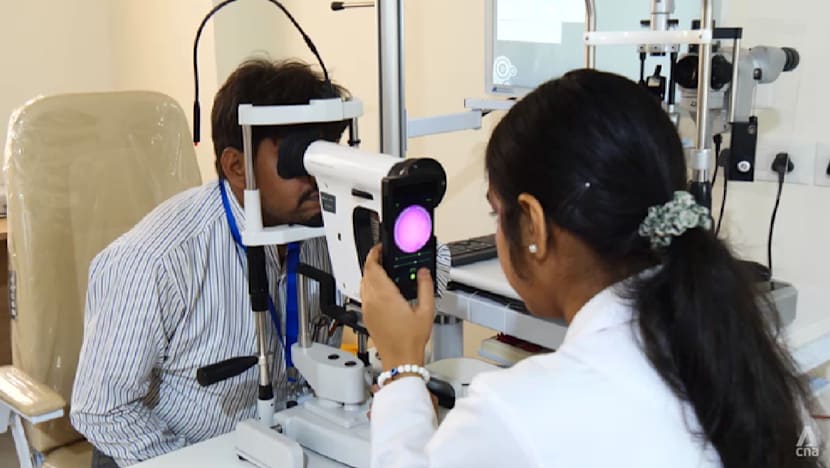
India turns to AI to improve healthcare access
Summarized and contextualized by DistantNews.
At a glance
News
Named sources
Context piece
- Indian hospitals are using artificial intelligence to improve healthcare access, particularly for eye diseases.
- AI tools analyze retinal scans and medical images, enabling healthcare workers with less training to perform initial screenings.
- This technology helps in early detection of conditions like glaucoma and diabetic retinopathy, increasing efficiency and reducing costs.
Hospitals in India are increasingly integrating artificial intelligence into their healthcare services to broaden access, especially in remote areas. At the Shantilal Shanghvi Eye Institute in Mumbai, AI-powered smartphone-based retinal imaging devices are being used to screen patients from nearby slums for early signs of eye conditions such as glaucoma and diabetic retinopathy. This technology allows healthcare workers with limited specialist training to conduct initial assessments, significantly speeding up the process. Radhika Krishnan, head of public health at the institute, highlighted that AI enables "task shifting" of the screening process to less-trained personnel, allowing for regular triaging of a larger population. For patients like labourer Mohammad Javed Shaikh, this means less time off work, as he recalled spending entire days at government hospitals in the past. The AI eye screening tool, developed by Remidio, is also cost-effective, with devices costing around $3,700 and annual software subscriptions for unlimited scans at $1,500. Beyond eye care, AI is also boosting productivity in radiology. TrueCheck Diagnostics in Mumbai uses a platform developed by 5C Network, which has trained its AI on billions of medical images. This system generates draft reports for radiologists to review, addressing India's shortage of specialists, which is estimated at one radiologist per 100,000 people. TrueCheck reports that the technology has improved their diagnostic efficiency.
The game-changer in terms of AI is we have been able to task shift the screening process to less-trained people, who can use the AI to triage people who require the ophthalmologist's opinion.
DistantNews Editorial
Originally published by CNA. Summarized and contextualized by our editorial team with added local perspective. Read our editorial standards.
More Stories



From Our Blog

What Gets Lost (and Found) When News Is Translated

The Critical Role of Diaspora Media in Global News

What Travellers Should Know About Countries with Restricted Press

A Digital Nomad's Guide to Following Local News

How the Same Story Looks Different in Different Countries
