


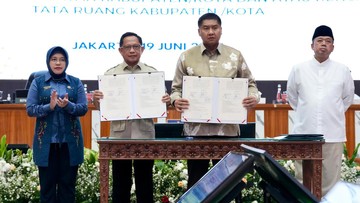
Indonesian ministers sign decree to speed up 3-million-house program
Translated from Indonesian, summarized and contextualized by DistantNews.
At a glance
News
Sources not specified
New plan
- Indonesian ministers signed a joint decree to accelerate the government's 3-million-house development program.
- The decree strengthens legal grounds for regional governments to support housing provision for low-income communities.
- It expands the definition of low-income communities and eases domicile requirements for accessing housing subsidies.
Indonesia's Minister of Home Affairs, Muhammad Tito Karnavian, and Minister of Public Housing and Settlement Areas, Maruarar Sirait, have signed a joint decree aimed at accelerating the national program to build 3 million houses. This initiative is a priority program of President Prabowo Subianto, designed to provide housing for low-income communities (MBR).
The joint decree provides a stronger legal basis for regional governments to support housing provision. The government has implemented policies to reduce homeownership costs for MBRs, including exemptions from building permit fees (PBG) and land and building acquisition taxes (BPHTB). These measures aim to make it easier for citizens to obtain or build homes and for developers to construct affordable housing.
To broaden access to the 3-million-house program, the decree revises the classification of MBRs from two to four zones. This adjustment aligns recipient criteria with regional economic conditions. For instance, income thresholds for MBRs in Jakarta, Bogor, Depok, Tangerang, and Bekasi (Jabodetabek) have been increased due to higher land and housing costs. Unmarried individuals in these areas can now qualify with incomes up to 12 million rupiah, and married individuals up to 14 million rupiah, a significant increase from previous limits.
Addressing issues of domicile that previously hindered access to housing facilities, the decree clarifies that ease of access to PBG and BPHTB exemptions will not be restricted by local ID card (KTP) requirements. This means individuals working in one area, such as Jakarta, but purchasing homes in surrounding areas like Bekasi or Tangerang due to affordability, can still access these benefits without needing to change their registered domicile. The policy aims to simplify the process for low-income individuals regardless of their registered address.
DistantNews Editorial
Originally published by CNN Indonesia in Indonesian. Translated, summarized, and contextualized by our editorial team with added local perspective. Read our editorial standards.
More Stories


From Our Blog

What Gets Lost (and Found) When News Is Translated

The Critical Role of Diaspora Media in Global News

What Travellers Should Know About Countries with Restricted Press

A Digital Nomad's Guide to Following Local News

How the Same Story Looks Different in Different Countries
