


Indonesian Police Uncover Rp36 Billion Counterfeit Money Factory
Translated from Indonesian, summarized and contextualized by DistantNews.
At a glance
News
Official statement
Under investigation
- Indonesian police uncovered a counterfeit money operation in Tangerang Selatan, seizing fake Rp100,000 bills totaling Rp36 billion.
- The operation used printing molds from the 2016 rupiah emission, and the fake currency had not yet entered circulation.
- Authorities are investigating the syndicate's distribution network and potential links to other counterfeit operations, with a suspected 3:1 exchange rate for profit.
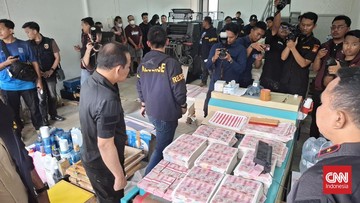
Authorities in Indonesia have dismantled a large-scale counterfeit money operation in Tangerang Selatan, confiscating an estimated Rp36 billion in fake Rp100,000 banknotes. The Directorate of Special Criminal Investigation of the Jakarta Metropolitan Police revealed that the syndicate was using printing molds from the 2016 rupiah emission to produce the illicit currency.
What was used was the 2016 printing. Because there is a difference between 2022 and 2016, everything is the same, the printing uses 2016.
Kombes Victor Dean Mackbon, Director of Special Criminal Investigation, confirmed that the counterfeit bills, totaling 360,000 pieces, had not yet been circulated among the public. However, police are actively investigating the suspects' accounts to understand their planned distribution methods. "This item has not yet circulated, but we will investigate further based on the suspects' statements," Victor stated.
This item has not yet circulated, but we will investigate further based on the suspects' statements.
The investigation is also exploring potential connections between this syndicate and previously uncovered counterfeit operations. Police are examining two suspected distribution channels: one involving individuals who provided capital and directed production, and another from the production group itself, each with their own distribution networks. The primary motive appears to be economic gain, with a suspected scheme involving exchanging three counterfeit bills for one genuine note (a 3:1 ratio).
So, the 360,000 sheets are not directed to one source, but to two sources later.
Further complicating the investigation, police uncovered information suggesting the syndicate planned to deposit the fake money into a private bank, likely by mixing it with genuine currency. This plan is a key focus as investigators work to identify all individuals involved in both the production and distribution of the counterfeit currency. In addition to the fake money, police seized production equipment valued at approximately Rp1 billion, including an offset printing machine and related devices.
From three counterfeit bills, it is equivalent to one genuine bill. Yes, or we can say 3 to 1. So that's where the profit is taken from.
DistantNews Editorial
Originally published by CNN Indonesia in Indonesian. Translated, summarized, and contextualized by our editorial team with added local perspective. Read our editorial standards.
More Stories


From Our Blog

What Gets Lost (and Found) When News Is Translated

The Critical Role of Diaspora Media in Global News

What Travellers Should Know About Countries with Restricted Press

A Digital Nomad's Guide to Following Local News

How the Same Story Looks Different in Different Countries
