


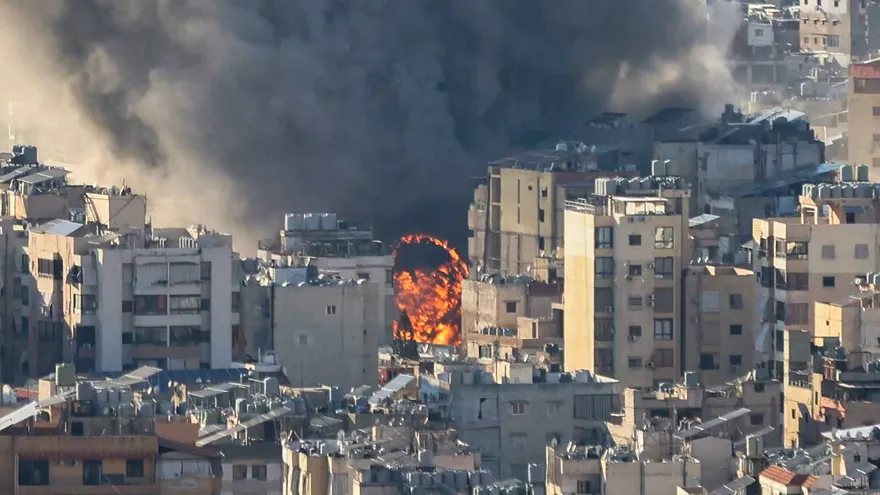
Iran attacks Bahrain and Kuwait following new U.S. strikes
Translated from Spanish, summarized and contextualized by DistantNews.
At a glance
News
Sources not specified
Ongoing story
- Iran launched missile attacks on Bahrain and Kuwait, U.S. allies, following new U.S. strikes.
- The attacks have intensified tensions and drawn strong condemnation from the Gulf monarchies.
- U.S. Central Command reported intercepting Iranian drones and subsequently striking Iranian radar sites.
Iran launched a barrage of missiles at Bahrain and Kuwait, both U.S. allies, on Saturday, escalating tensions after new U.S. strikes. The attacks prompted strong responses from the Gulf monarchies and further strained a fragile truce in the region. Weeks of indirect talks, marked by reciprocal threats and sporadic exchanges of fire, have failed to secure a lasting agreement to end the war or reopen the Strait of Hormuz, a critical chokepoint for global oil and gas shipments.
We woke up to a huge explosion. My children were terrified, and I couldn't calm them.
U.S. Central Command (CENTCOM) reported intercepting four Iranian attack drones aimed at the strait on Friday night. Subsequently, U.S. forces targeted Iranian coastal surveillance radar sites. The Iranian Revolutionary Guard declared on Saturday that it had retaliated by firing missiles at "enemy bases in the area." CENTCOM stated that Iran launched seven ballistic missiles toward Bahrain and Kuwait, with six being intercepted and one failing to reach its target.
Negotiations are stalled, and Trump must break this deadlock.
Bahrain, which hosts the U.S. Fifth Fleet headquarters, denounced the latest attacks as "flagrant aggression," while Kuwait described them as "a dangerous escalation." In Manama, Bahrain's capital, an AFP journalist heard three explosions amid air raid sirens. In Kuwait, another AFP journalist reported hearing repeated explosions near the international airport, site of a Wednesday attack attributed to Iran that left one dead. "We woke up to a huge explosion," said Reem, a mother of two. "My children were terrified, and I couldn't calm them."
flagrant violations
The ceasefire in the nearly 100-day-old war, triggered by U.S. and Israeli attacks, has held since April 8, despite occasional flare-ups. Iran's Foreign Ministry condemned the latest U.S. strikes as "flagrant" violations and denounced Washington's "hostile and provocative behavior." Efforts to convert the truce into a durable agreement have repeatedly stalled, while the conflict has shaken global markets and increased pressure on U.S. President Donald Trump ahead of midterm elections. "Negotiations are stalled, and Trump must break this deadlock," Mohsen Rezaei, a military advisor to Iran's supreme leader, told CNN, calling for the release of approximately $24 billion in frozen Iranian assets. Washington might instead seek to use these funds to cover damages caused by Iranian attacks on its Gulf allies.
hostile and provocative behavior
DistantNews Editorial
Originally published by TVN Panamá in Spanish. Translated, summarized, and contextualized by our editorial team with added local perspective. Read our editorial standards.
More Stories


From Our Blog

What Gets Lost (and Found) When News Is Translated

The Critical Role of Diaspora Media in Global News

What Travellers Should Know About Countries with Restricted Press

A Digital Nomad's Guide to Following Local News

How the Same Story Looks Different in Different Countries
