


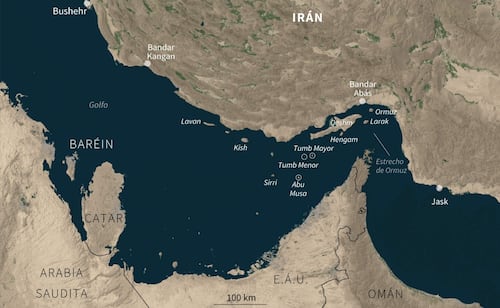
Iran closes Strait of Hormuz; Revolutionary Guard accuses foreign ships of using unauthorized routes
Translated from Spanish, summarized and contextualized by DistantNews.
At a glance
News
Official statement
Ongoing story
- Iran's Revolutionary Guard closed the Strait of Hormuz after firing warning shots at a ship using an unauthorized route.
- The IRGC cited "external interference" from foreign powers as the reason for the closure, which will last until further notice.
- The U.S. announced a third round of strikes against Iran following an incident where an IRGC-flagged vessel allegedly attacked a commercial ship, leaving a crew member missing.
Iran's Islamic Revolutionary Guard Corps (IRGC) announced the closure of the Strait of Hormuz, firing warning shots at a vessel attempting to transit the vital waterway via an unauthorized route. The IRGC cited "external interference" from foreign powers as the justification for the indefinite closure.
Given the precariousness caused by this illicit third-party interference, the Strait of Hormuz will remain closed until further notice and until regional interference from the United States ceases.
In a statement released by the semi-official Tasnim news agency, the IRGC declared, "Given the precariousness caused by this illicit third-party interference, the Strait of Hormuz will remain closed until further notice and until regional interference from the United States ceases." The statement explicitly warned that "no vessel or naval craft will be allowed passage."
No vessel or naval craft will be allowed passage.
This action follows the U.S. military's announcement of a third round of strikes against Iran this week. U.S. Central Command (CENTCOM) reported that the IRGC "blatantly attacked" a Cyprus-flagged container ship, the M/V GFS Galaxy, transiting the Strait of Hormuz. The incident resulted in significant damage to the vessel and the disappearance of one crew member.
Iran was given another opportunity to demonstrate its adherence to the Memorandum of Understanding after being held accountable for previous attacks on commercial vessels, but once again it has failed.
CENTCOM criticized Iran's actions, stating, “Iran was given another opportunity to demonstrate its adherence to the Memorandum of Understanding after being held accountable for previous attacks on commercial vessels, but once again it has failed.” U.S. Secretary of Defense Pete Hegseth commented on social media, "Iran made a bad decision. Now they will pay the consequences."
Iran took a bad decision. Now they will pay the consequences.
DistantNews Editorial
Originally published by El Universal in Spanish. Translated, summarized, and contextualized by our editorial team with added local perspective. Read our editorial standards.
More Stories


From Our Blog

What Press Freedom Means for the News You Read

What Gets Lost (and Found) When News Is Translated

The Critical Role of Diaspora Media in Global News

What Travellers Should Know About Countries with Restricted Press

A Digital Nomad's Guide to Following Local News
