

Iran President: US Memorandum is Best Path Out of Stalled War
Summarized and contextualized by DistantNews.
At a glance
News
Named sources
Context piece
- Iranian President Masoud Pezeshkian stated a recent memorandum of understanding is the best path to resolve the country's "neither war nor peace" situation.
- He asserted the agreement upholds dignity, wisdom, and national interest, refuting claims of capitulation and emphasizing adherence to the supreme leader's policies.
- The memorandum, signed by US President Donald Trump, aimed to end the war and nuclear program dispute within 60 days, a deadline that passed with significant disagreements remaining, particularly on the Strait of Hormuz.
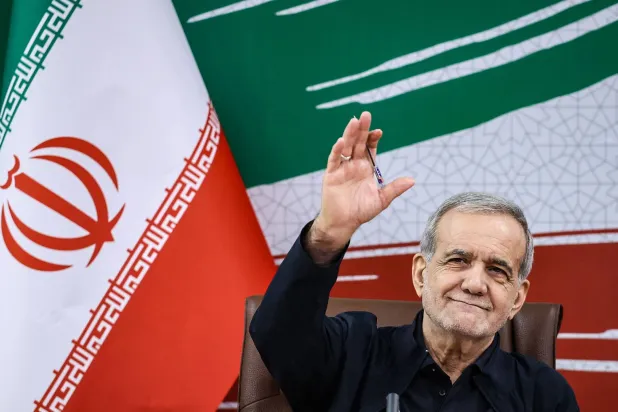
Iranian President Masoud Pezeshkian has defended a recent memorandum of understanding as the most effective route for Iran to exit a state of "neither war nor peace." Speaking in a speech published by state-run IRNA, Pezeshkian stated that members of Iran’s Supreme National Security Council viewed the memorandum as the best achievable agreement, prioritizing dignity, wisdom, and national interests. He explicitly denied that any provision within the deal constituted capitulation, affirming that the nation would follow the policies set by the supreme leader.
There is not a single provision in this agreement that amounts to capitulation.
The agreement, known as the Memorandum of Understanding, was signed by US President Donald Trump in June with an ambitious 60-day target to conclude the war with Iran and reach a resolution on its nuclear program. This deadline has now passed without a resolution, and significant divides persist between the two sides. A key point of contention remains the reopening of the Strait of Hormuz, a critical waterway for global shipping, with no signs of compromise evident.
The supreme leader sets the policies, and we will follow that path.
Pezeshkian also highlighted the economic implications of the current stalemate, explaining that Iran's inability to attract investment is directly linked to the ongoing uncertainty. "Capital and money are extremely sensitive to risk," he was quoted as saying by The Associated Press. "We have to remove this risk from the country." The Iranian economy has been under considerable strain due to sanctions and a naval blockade, which severely hampers oil exports, the country's primary source of revenue, nearly six months into the conflict with the United States and Israel.
Capital and money are extremely sensitive to risk. We have to remove this risk from the country.
Adding to the tensions, Mohsen Rezaei, the newly appointed hard-line leader of Iran’s Supreme National Security Council, issued a warning to Iran's neighbors against supporting the US efforts to cripple Iran's economy. In an interview with state broadcaster IRIB, Rezaei stated, "If (Trump) wants to do something, we will retaliate in a seismic manner." His appointment this month is seen as part of a broader hardening of Tehran's political and military posture, and this interview represents his most substantial public statement since taking office.
If (Trump) wants to do something, we will retaliate in a seismic manner.
DistantNews Editorial
Originally published by Asharq Al-Awsat. Summarized and contextualized by our editorial team with added local perspective. Read our editorial standards.
More Stories


From Our Blog

What Gets Lost (and Found) When News Is Translated

The Critical Role of Diaspora Media in Global News

What Travellers Should Know About Countries with Restricted Press

A Digital Nomad's Guide to Following Local News

How the Same Story Looks Different in Different Countries
