


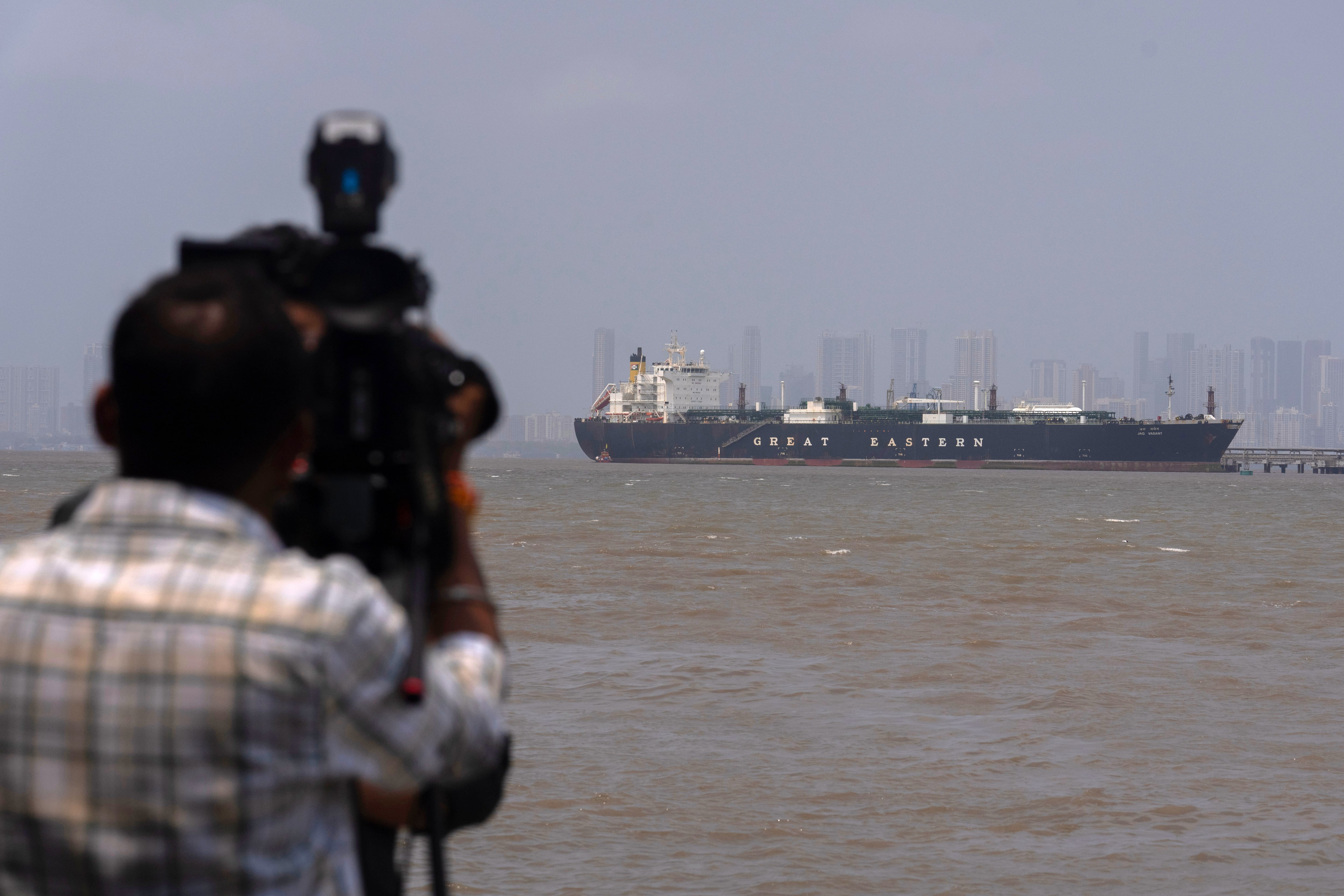
Iran's New Strategy: Vessel Captures in Hormuz Strait Amidst Nuclear and Political Tensions
Translated from Spanish, summarized and contextualized by DistantNews.
TLDR
- Iran's Revolutionary Guard captured three civilian vessels in the Strait of Hormuz using fast boats, a move analyzed as a new strategy by the regime.
- Analyst Andrés Repetto described the tactic as similar to US Navy operations, though executed with more basic means.
- Iran's President conditioned the opening of the Strait of Hormuz on the US lifting its blockade on Iranian ships, while the UN warned of Iran's uranium enrichment levels.
Argentina's La Nación analyzes Iran's assertive actions in the Strait of Hormuz and the broader geopolitical implications.
The Iranians, a bit more precarious, climbing ladders to take. But the result is the same. The capture of not one ship, but three, which are already on the coast of Iran.
The recent capture of three civilian vessels by Iran's Revolutionary Guard in the Strait of Hormuz represents a calculated escalation by the regime. Analyst Andrés Repetto, speaking on LN+, likened the operation to U.S. Navy commando tactics, noting the Iranians' use of ladders to board the ships. This maneuver, while perhaps less sophisticated in execution, achieves the same objective: asserting control and projecting power in a critical global waterway.
Tehran's official stance, articulated by President Masoud Pezeshkian, links the passage through Hormuz to U.S. sanctions. The President declared that Iran welcomes dialogue but blames the U.S. for "hypocritical talks" and "bad faith" due to the "blockade" preventing Iranian ships from accessing the Gulf. This framing positions Iran as a victim of American aggression, seeking concessions rather than engaging in genuine negotiation.
The Islamic Republic of Iran has always welcomed dialogue and agreement, and it does so currently. Bad faith, blockade, and threats are the main obstacle to real negotiation. The world is witnessing your hypocritical talks and the contradiction between your claims and your actions.
Adding to the regional tension, the International Atomic Energy Agency's director, Rafael Grossi, has raised concerns about Iran's uranium enrichment levels, suggesting they far exceed civilian needs and could be geared towards nuclear weapons development. This nuclear dimension, coupled with the maritime assertiveness, paints a complex picture of Iran's strategic calculus. The international community watches closely, aware that these actions occur against a backdrop of internal political shifts, as evidenced by recent dismissals within the Pentagon, suggesting a broader instability.
Uranium is vital at the level Iran has enriched it. Clearly, what it has done is not for civilian use, but the question is how far it is eventually, which they have not answered, how far it is eventually and if it has the capacity to manufacture it.
From our perspective in Argentina, these events in the Middle East underscore the volatile nature of international relations and the constant struggle for influence in strategic regions. While Western media might focus on the immediate security implications, we also recognize the intricate web of economic pressures, political posturing, and internal dynamics that drive such actions. Iran's strategy appears to be one of enduring international pressure to extract economic concessions, a tactic that has long-term implications for global trade and stability.
We are also seeing that there is an internal crisis. Within the Pentagon, none other than the Secretary of the Navy, the man who had, on his shoulders, the entire military operation at a time when the war moved to naval operations, was fired, and he is not the first high-ranking Pentagon official to be fired.
DistantNews Editorial
Originally published by La Nación in Spanish. Translated, summarized, and contextualized by our editorial team with added local perspective. Read our editorial standards.
More Stories



From Our Blog

What Gets Lost (and Found) When News Is Translated

The Critical Role of Diaspora Media in Global News

What Travellers Should Know About Countries with Restricted Press

A Digital Nomad's Guide to Following Local News

How the Same Story Looks Different in Different Countries
