


Israel launches bounty hunt for invasive red lionfish
Translated from English, summarized and contextualized by DistantNews.
At a glance
News
Sources not specified
New plan
- Israel has launched a bounty program allowing licensed sport fishermen to hunt invasive red lionfish starting June 1.
- The lionfish, native to the Indian Ocean and Red Sea, entered the Mediterranean via the Suez Canal and poses a significant threat to marine ecosystems.
- This initiative marks an unprecedented collaboration between the Agriculture Ministry, environmental group Zalul, and the Sport Fishing Association to combat the invasive species.
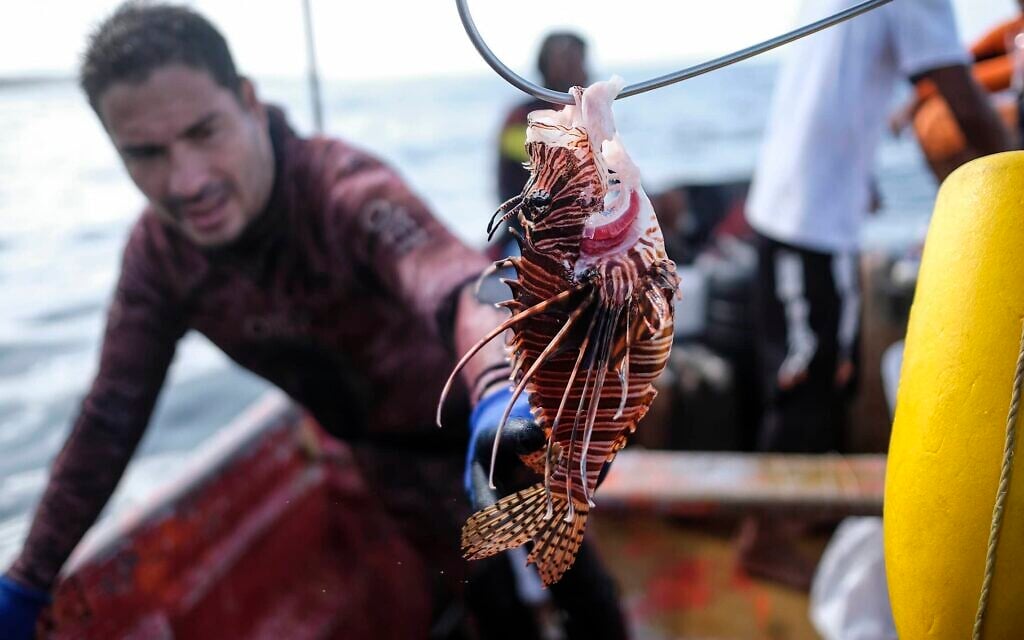
A unique coalition has formed off the coast of Israel to combat a "professional troublemaker" in the Mediterranean Sea: the red lionfish. Starting June 1, thousands of Israelis with sport-fishing licenses are authorized to hunt these strikingly beautiful but ecologically damaging fish, with a bounty placed on their heads.
it is a very aggressive predator. It preys on small fish, destroys their habitats, and takes over territories.
This campaign represents the first time the Agriculture Ministry, the environmental organization Zalul, and the Sport Fishing Association, groups that typically have differing interests, have united against a common enemy. The red lionfish is considered one of the most significant threats to the region's marine ecosystem.
An invasive species, the lionfish naturally belongs to the Indian Ocean and Red Sea, where its population is controlled by natural predators. However, it reached Israeli shores and the Mediterranean through the Suez Canal, a phenomenon known as Lessepsian migration. The lionfish, measuring 12 to 16 inches, is a highly aggressive predator that consumes small fish, destroys habitats, and displaces native species like lobsters. "In areas where there used to be lobster colonies, you see that the lobsters have disappeared and lionfish have taken their place," said Guy Rubinstein, director of the Fisheries Division at the Agriculture Ministry.
In areas where there used to be lobster colonies, you see that the lobsters have disappeared and lionfish have taken their place.
"This is a very problematic invasive species," stated Dr. Yuval Arbel, deputy director of Zalul. "Everywhere it has been allowed to reproduce, in the Caribbean or the Mediterranean, there has been severe damage." Studies indicate that local fish populations decline by as much as 80% in areas dominated by lionfish. A single female can produce 30,000 eggs per spawning, contributing to its rapid proliferation. The initiative aims to curb this expansion by engaging fishermen in the hunt.
This is a very problematic invasive species. Everywhere it has been allowed to reproduce, in the Caribbean or the Mediterranean, there has been severe damage.
DistantNews Editorial
Originally published by Times of Israel in English. Translated, summarized, and contextualized by our editorial team with added local perspective. Read our editorial standards.
More Stories



From Our Blog

What Gets Lost (and Found) When News Is Translated

The Critical Role of Diaspora Media in Global News

What Travellers Should Know About Countries with Restricted Press

A Digital Nomad's Guide to Following Local News

How the Same Story Looks Different in Different Countries
