


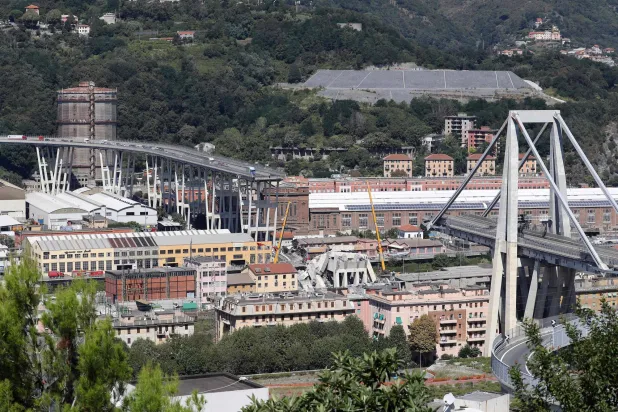
Italy Court Finds 32 People Guilty Over Deadly Genoa Bridge Collapse
Summarized and contextualized by DistantNews.
At a glance
News
Named sources
Outcome reported
- An Italian court sentenced 32 individuals, including the former head of Autostrade, for the 2018 Genoa bridge collapse that killed 43 people.
- Former Autostrade CEO Giovanni Castellucci received a 12-year sentence for vehicular homicide and negligence.
- Relatives of victims expressed a desire for justice, while some defendants plan to appeal the ruling.
An Italian court has convicted 32 defendants, including former executives of the motorway operator Autostrade, for their roles in the deadly 2018 collapse of Genoa's Morandi Bridge. The disaster claimed the lives of 43 people when the structure gave way during torrential rain.
Today we can say there are those guilty of the murder of our relatives.
Giovanni Castellucci, the former chief executive of Autostrade, received the harshest sentence of 12 years in prison. He was found guilty of vehicular homicide and negligence, with prosecutors arguing he postponed crucial maintenance work. Castellucci is already serving time for a separate 2013 accident where a bus fell from a viaduct, killing 40 people.
Relatives of the victims expressed a mix of grief and a demand for accountability. "Today we can say there are those guilty of the murder of our relatives," said Michele Matti Altadonna, whose brother died in the collapse. "We are here for our loved ones, in their memory." While some defendants, including Castellucci, intend to appeal, Altadonna vowed to continue seeking justice for his brother's children.
We are here for our loved ones, in their memory.
The court's investigation highlighted a severe lack of maintenance, noting that "not even minimal maintenance work was carried out to reinforce the stays of pillar number nine" in the 51 years between the bridge's inauguration and its collapse. Prosecutors asserted that the disaster "could have been avoided."
for the four children my brother left behind... we will not give up, we will not give up until the Supreme Court
Italy's deputy transport secretary, Edoardo Rixi, called the ruling an "important step on the path of truth and justice," stating that the collapse was not an act of fate but a consequence of "serious errors and omissions by those who had a duty to ensure safety."
Between the inauguration in 1967 and the collapse, i.e. 51 years later, not even minimal maintenance work was carried out to reinforce the stays of pillar number nine.
DistantNews Editorial
Originally published by Asharq Al-Awsat. Summarized and contextualized by our editorial team with added local perspective. Read our editorial standards.
More Stories



From Our Blog

What Gets Lost (and Found) When News Is Translated

The Critical Role of Diaspora Media in Global News

What Travellers Should Know About Countries with Restricted Press

A Digital Nomad's Guide to Following Local News

How the Same Story Looks Different in Different Countries
