


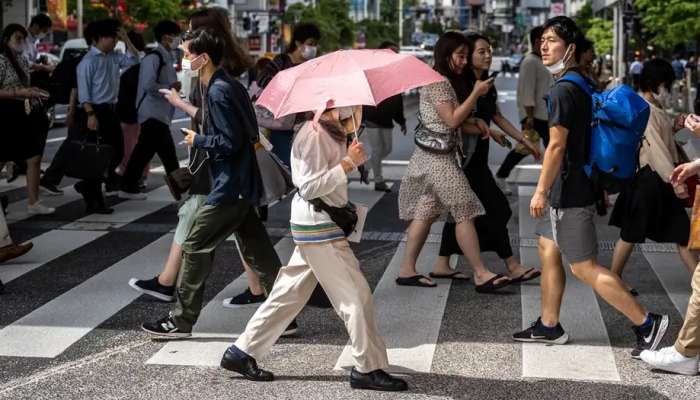
Japan raises visa fees tenfold, straining foreign workers' finances
Translated from English, summarized and contextualized by DistantNews.
At a glance
News
Sources not specified
Context piece
- Japan is raising visa and permanent residency fees tenfold, creating financial hurdles for foreign workers.
- The government aims to tighten immigration policies despite a growing reliance on foreign labor to offset demographic decline.
- Foreign workers are deemed indispensable for Japan's functioning, supporting fundamental infrastructure and caregiving fields.
Srijana Sunar, a 29-year-old Nepali woman working in Japan since 2018, expressed shock at the government's decision to raise visa extension fees tenfold. "I was shocked. It is too much to pay 100,000 yen to extend my visa every three years," she told DW, noting her monthly earnings are 145,000 yen.
I was shocked. It is too much to pay 100,000 yen to extend my visa every three years
Her husband, Spandan Sunar, who has worked in Japan since 2016, feels his long-term efforts have not been rewarded. "We are not newcomers. We have proper visa status, we follow the rules and we pay taxes, but our freedom to choose jobs and working conditions is very limited," he said. The couple hopes to apply for permanent residency, but the increased fee of 300,000 yen, coupled with an annual income requirement of over 3 million yen, presents a significant challenge.
These changes come as Japan grapples with a declining native population, with numbers falling by 941,000 in the year to April 2025. Foreign nationals, numbering around 4.125 million at the end of 2025, are offsetting about 40% of this decline.
We are not newcomers. We have proper visa status, we follow the rules and we pay taxes, but our freedom to choose jobs and working conditions is very limited
Toshihiro Menju, an immigration policy expert, emphasized the indispensability of foreign workers. "Foreign workers are indispensable. Without them, society would not function," he stated, adding that relying solely on women's participation or robots is insufficient. He noted the increasing presence of foreign workers across various sectors, from skilled professions to caregiving, supporting the nation's fundamental infrastructure.
Foreign workers are indispensable. Without them, society would not function
Despite this reliance, the Japanese government, under Prime Minister Sanae Takaichi, agreed in January on stricter measures for foreign nationals. These include doubling the residency requirement for naturalization to 10 years and introducing Japanese language proficiency tests for permanent residency. The government established a "Headquarters for Foreign Nationals Policy" in November 2025 to manage these new regulations.
It is impossible to fully make up for labor shortages through women's participation or the use of robots alone
DistantNews Editorial
Originally published by Times of Oman in English. Translated, summarized, and contextualized by our editorial team with added local perspective. Read our editorial standards.
More Stories


From Our Blog

What Gets Lost (and Found) When News Is Translated

The Critical Role of Diaspora Media in Global News

What Travellers Should Know About Countries with Restricted Press

A Digital Nomad's Guide to Following Local News

How the Same Story Looks Different in Different Countries
