


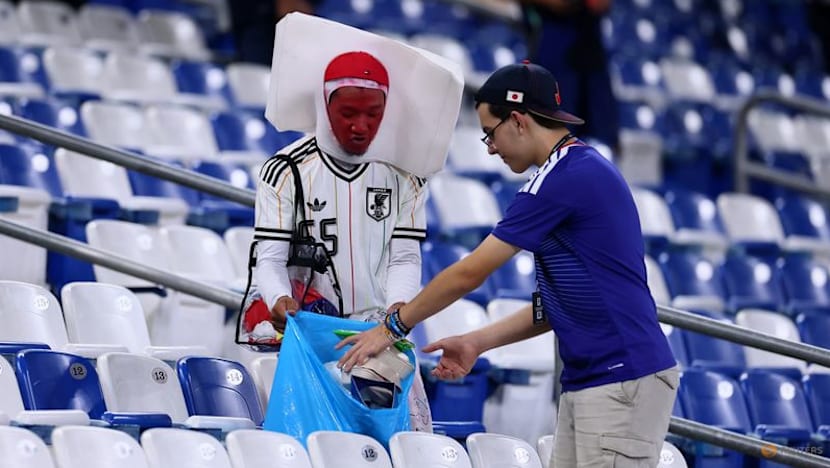
Japanese Fans Clean Stadium After World Cup Victory, Showcasing Cultural Practice
Translated from English, summarized and contextualized by DistantNews.
At a glance
News
From a news agency
Context piece
- Japanese fans cleaned up a stadium in Monterrey after their team's 4-0 victory over Tunisia in the World Cup.
- The practice, known as 'gomi hiroi' in Japan, reflects a cultural emphasis on taking responsibility for shared spaces.
- Fans expressed that this tradition is a way to show appreciation for the hospitality received in Mexico and is a source of pride on the global stage.
Japanese fans demonstrated their unique cultural practice of 'gomi hiroi,' or rubbish cleaning, after Japan's decisive 4-0 victory over Tunisia in their World Cup match in Monterrey. The fans stayed behind in the stadium to meticulously collect litter from the stands, turning a post-match celebration into an act of civic responsibility.
We are guests in Mexico. I have been treated wonderfully, so this is my way of showing my appreciation.
This tradition, deeply ingrained in Japanese culture from a young age, emphasizes taking ownership of shared spaces. Ken Okawa, attending his first World Cup match, explained his motivation: "We are guests in Mexico. I have been treated wonderfully, so this is my way of showing my appreciation." The practice is a familiar sight in Japan, where schoolchildren are taught to clean their own classrooms.
It's a natural part of our culture. We do this to ensure that everything we use is left clean so that the next person can use it comfortably.
Miku Takeya, another fan, described the habit as second nature. "It's a natural part of our culture," she said. "We do this to ensure that everything we use is left clean so that the next person can use it comfortably." Images of Japanese fans tidying up stadiums during the World Cup have circulated widely online, drawing international attention.
It's common sense in Japan.
Local authorities in Nuevo León even arranged for 20,000 trash bags to be distributed in the stadium and other tourist sites, responding to requests from Japanese fans. Despite the global fascination, many Japanese fans, like Ichiro Oyo, consider it "common sense in Japan." However, Ryo Matsuoka expressed pride in showcasing this aspect of Japanese culture on a global stage, stating, "I think it is a matter of great pride that this is being showcased in a stadium like this, where people from all over the world are watching."
I think it is a matter of great pride that this is being showcased in a stadium like this, where people from all over the world are watching.
DistantNews Editorial
Originally published by CNA in English. Translated, summarized, and contextualized by our editorial team with added local perspective. Read our editorial standards.
More Stories



From Our Blog

What Gets Lost (and Found) When News Is Translated

The Critical Role of Diaspora Media in Global News

What Travellers Should Know About Countries with Restricted Press

A Digital Nomad's Guide to Following Local News

How the Same Story Looks Different in Different Countries
