


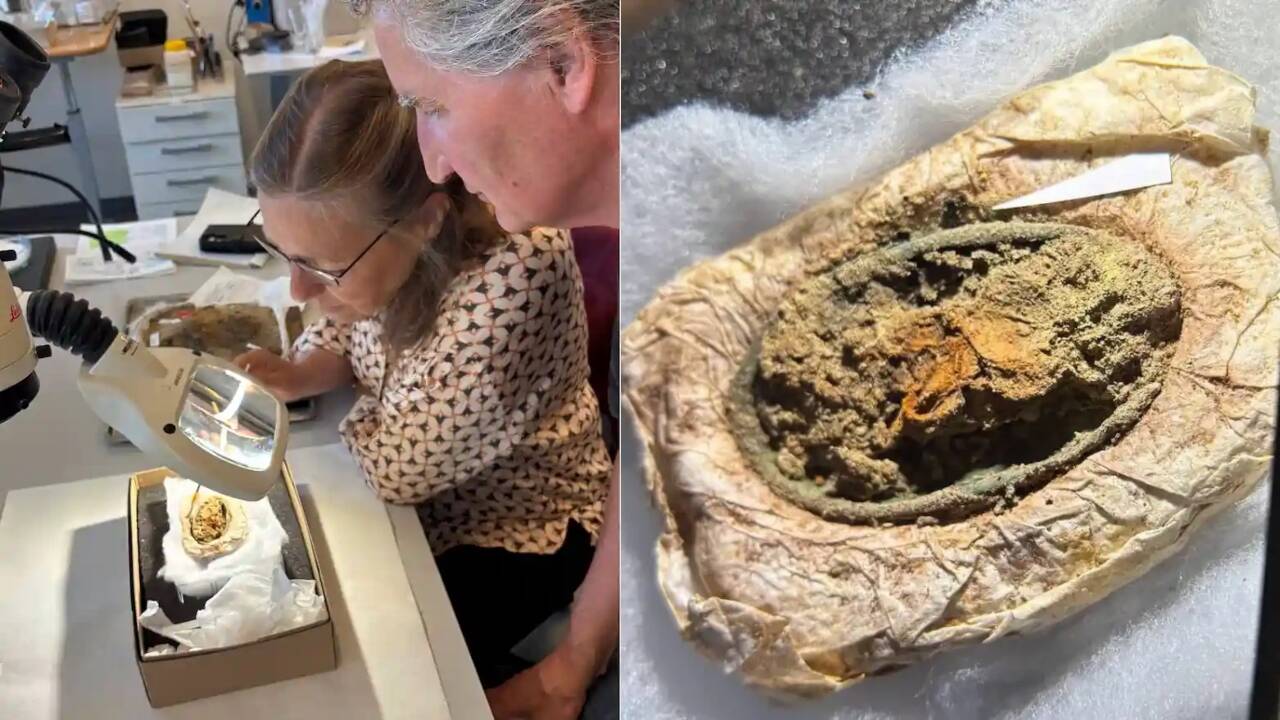
Jewelry Preserves Viking Woman's Clothes for 1,300 Years
Translated from English and summarized by DistantNews. Read the original for the full story.
At a glance
In-depth
Sources not specified
Context piece
- Archaeologists in Denmark found rare textile fragments from a Viking woman's grave, dating back 1,300 years.
- The wool and linen fragments survived due to metal salts released from two brooches that fastened her clothing.
- Analysis of the preserved textiles will provide insights into Viking-era fibers, sewing techniques, and garment construction.
In a remarkable discovery near Varde, Denmark, archaeologists have unearthed rare textile remains from a Viking woman's grave, offering an unprecedented glimpse into clothing from approximately 1,300 years ago. The fragments of wool and linen, found at the Skonager site, survived against considerable odds in the acidic soil that typically disintegrates such delicate materials.
The discovery at Skonager in Western Jutland, Denmark, has given researchers something almost impossible to find: textile scraps from an 8th-century burial, preserved not in some ideal climate-controlled cave but in soil so acidic it normally dissolves cloth to nothing.
The key to this extraordinary preservation lies in the two ornate brooches that once fastened the woman's clothing. As the bronze and silver jewelry corroded on her skeleton, they released metallic salts into the surrounding soil. These salts created a hostile environment for bacteria and fungi, effectively preventing the decomposition of the textile fibers. Thus, the very ornaments that held her dress together in life became its preservers in death.
Researchers are now meticulously analyzing the fragments, which were found clinging to both the upper and lower surfaces of the brooches. This positioning allows archaeologists to map the construction of the garment, distinguishing between the outer fabric displayed to the world and the inner layer worn against the skin. This detailed examination promises to reveal significant information about Viking fashion, including the types of fibers used, sewing techniques, and the overall structure of female garments from 8th-century Denmark.
In life, those very ornaments held her dress together, and after death, they ended up preserving it for history!
The extraction and analysis of these fragile remains are being conducted with extreme precision by a multidisciplinary team from the Vejle Conservation Center. Ancient textile specialist Lise Ræder Knudsen will examine the fibers to determine weaving patterns, thread quality, and the technical skill involved in creating the garment. Radiocarbon dating will also be employed to ascertain whether the woman wore a newly made dress with a repaired heirloom, or if both components belonged to the same period. This discovery is considered one of the most miraculous finds of the era, given the rarity of preserved textiles, especially those found in soil.
All these could help to determine if the woman who wore it had access to fine cloth.
About this summary
Originally published by Times of India in English. Translated, summarized, and contextualized automatically by DistantNews, with a note on how the source frames the story. Not individually reviewed before publishing. How this works.
More Stories


From Our Blog

What Press Freedom Means for the News You Read

What Gets Lost (and Found) When News Is Translated

The Critical Role of Diaspora Media in Global News

What Travellers Should Know About Countries with Restricted Press

A Digital Nomad's Guide to Following Local News
