


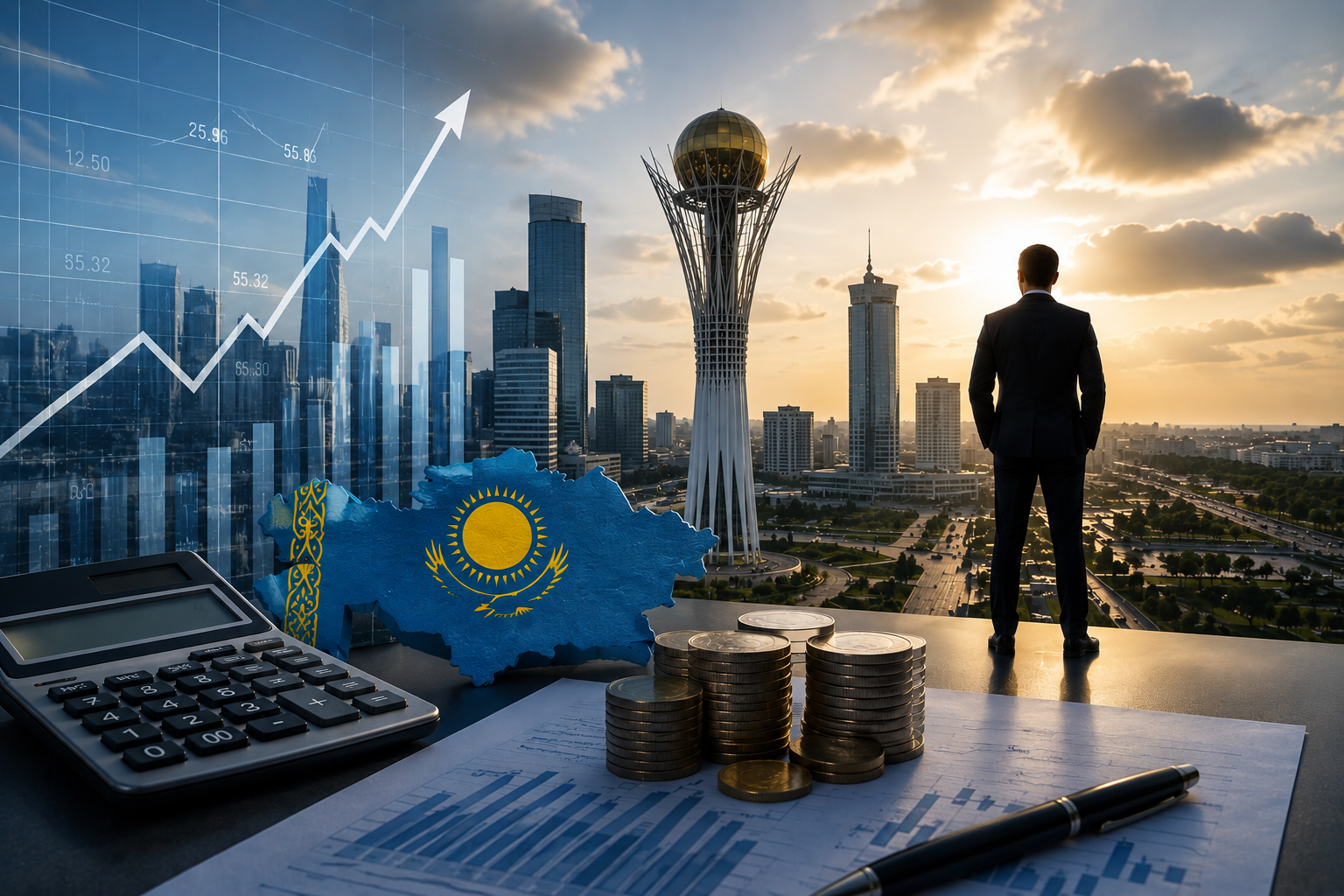
Kazakhstan Moves Up 17 Spots in Post-Shock Investment Risk Assessment
Summarized and contextualized by DistantNews.
At a glance
News
Documents & data
Context piece
- Kazakhstan significantly improved its investment risk assessment, climbing 17 spots to 53rd in the Global Investment Risk and Resilience Index.
- The index, updated in May 2026, combines long-term resilience with current market risk, with higher ranks indicating lower risk.
- Kazakhstan now leads Central Asia in foreign investment, accounting for nearly 66% of the region's total FDI stock, which reached $156.4 billion by 2025.
Kazakhstan has made a remarkable leap in its investment risk assessment, moving up 17 places to secure the 53rd position in the May 2026 update of the Global Investment Risk and Resilience Index. This significant improvement highlights the country's growing ability to withstand economic and geopolitical shocks.
In the span of three years, a pandemic, two major wars, a fragmenting trade system, and an energy shock emanating from the Middle East have forced every investor, government, and globally mobile family to ask the same question: where is safe, right now? And more importantly, will it still be safe a year from now?
The index, a collaboration between Henley & Partners, AlphaGeo, and incorporating Country Risk Premium data, evaluates countries based on a combination of long-term resilience indicators and current market risk. A higher ranking signifies a lower perceived risk and a greater capacity to navigate global uncertainties. In this latest edition, Kazakhstan's neighbors Uzbekistan, the Kyrgyz Republic, and Tajikistan ranked 81st, 96th, and 97th, respectively, while Switzerland, Denmark, and Norway led the index.
Parag Khanna, founder and CEO of AlphaGeo, noted that recent global events like the pandemic, major wars, and trade system fragmentation have forced a re-evaluation of investment safety. He observed that structural resilience and market-priced risk do not always align, creating opportunities. Khanna also emphasized that no single country offers complete protection, advising globally mobile families to diversify their access across multiple resilient economies.
First, structural resilience and market-priced risk do not always point the same way, and that gap is the most interesting thing on the map. It is where opportunity and mispricing live.
Kazakhstan's improved standing is further bolstered by its dominant position in Central Asia for foreign direct investment (FDI). According to the UN Trade and Development (UNCTAD) World Investment Report, Kazakhstan attracted nearly 66% of the region's total FDI. By 2025, the nation's accumulated FDI stock reached an impressive $156.4 billion, solidifying its role as a key investment destination.
Third, and most important for globally mobile families: no single jurisdiction offers complete protection anymore. The rational response is not to search for one perfect country. It is to build a portfolio of jurisdictional access, residence rights, citizenship options, asset location, and mobility pathways, diversified across structurally resilient economies.
DistantNews Editorial
Originally published by The Astana Times. Summarized and contextualized by our editorial team with added local perspective. Read our editorial standards.
More Stories


From Our Blog

What Gets Lost (and Found) When News Is Translated

The Critical Role of Diaspora Media in Global News

What Travellers Should Know About Countries with Restricted Press

A Digital Nomad's Guide to Following Local News

How the Same Story Looks Different in Different Countries
