


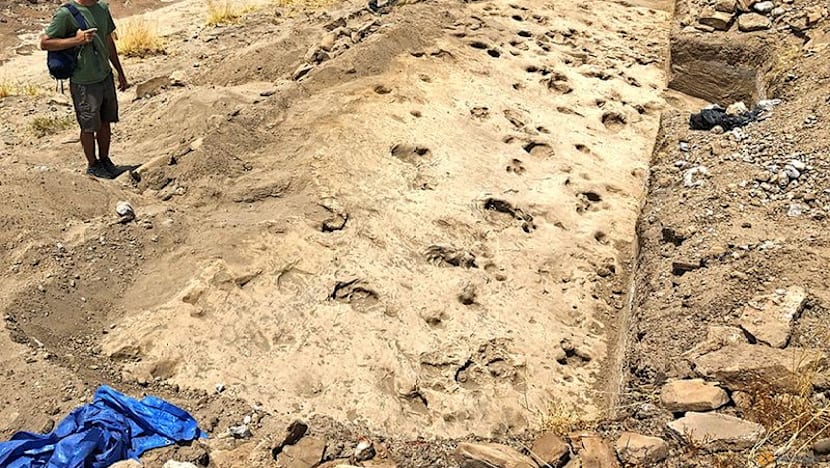
Kenyan footprints reveal size and social habits of ancient human cousin Paranthropus boisei
Translated from English, summarized and contextualized by DistantNews.
At a glance
News
Sources not specified
Context piece
- Fossilized footprints discovered in Kenya reveal new details about Paranthropus boisei, an extinct human relative known for its robust skull and large teeth.
- The 21 footprints, dating back 1.43 million years, suggest these individuals walked in groups and were larger than previously estimated, potentially rivaling Homo erectus in size.
- These findings offer insights into the social dynamics, locomotion, and physical characteristics of Paranthropus boisei, a species distinct from the lineage leading to modern humans.
Footprints preserved in mud along Kenya's Lake Turkana are offering a rare glimpse into the lives of Paranthropus boisei, an ancient human cousin that roamed the earth 1.43 million years ago. While this species is primarily known from fossilized skulls and teeth, the discovery of 21 footprints made by eight individuals provides unprecedented insight into their physical size and social behavior.
In all, this is another amazing snapshot that gives us insights into how these hominins looked, how they walked and how they engaged with each other and with their environments.
The tracks suggest that Paranthropus boisei males sometimes traveled in groups, moving across the landscape together. Researchers attribute the footprints to this species based on their distinctive shape and gait. The size of the prints indicates individuals potentially stood up to 6 feet tall and weighed around 165 pounds, challenging previous assumptions that they were smaller than their contemporary, Homo erectus.
"In all, this is another amazing snapshot that gives us insights into how these hominins looked, how they walked and how they engaged with each other and with their environments," said lead author Kevin Hatala, a paleoanthropologist at Chatham University. The robust skulls and massive teeth of Paranthropus boisei are well-documented, adapted for chewing tough vegetation like grasses and sedges. However, details about their post-cranial anatomy have been scarce until now.
Paranthropus boisei is most well known for their extremely robust skulls and very large teeth. From the neck down, we haven't known a lot about their anatomy.
These findings, published in the journal Proceedings of the National Academy of Sciences, also add to the understanding of hominin diversity in the region. Earlier discoveries showed Paranthropus boisei coexisted with Homo erectus, a species more closely related to modern humans. The new evidence suggests that despite their specialized diet and cranial features, Paranthropus boisei may have achieved body sizes comparable to Homo erectus, highlighting the varied evolutionary paths within the human lineage.
It had long been thought that they were smaller in body size than the contemporary Homo erectus, which is thought to have been very human-like in body size and shape. But perhaps Paranthropus boisei was also able to achieve human-like body sizes despite a cranial anatomy that seems to indicate a very different kind of diet.
DistantNews Editorial
Originally published by CNA in English. Translated, summarized, and contextualized by our editorial team with added local perspective. Read our editorial standards.
More Stories



From Our Blog

What Gets Lost (and Found) When News Is Translated

The Critical Role of Diaspora Media in Global News

What Travellers Should Know About Countries with Restricted Press

A Digital Nomad's Guide to Following Local News

How the Same Story Looks Different in Different Countries
