


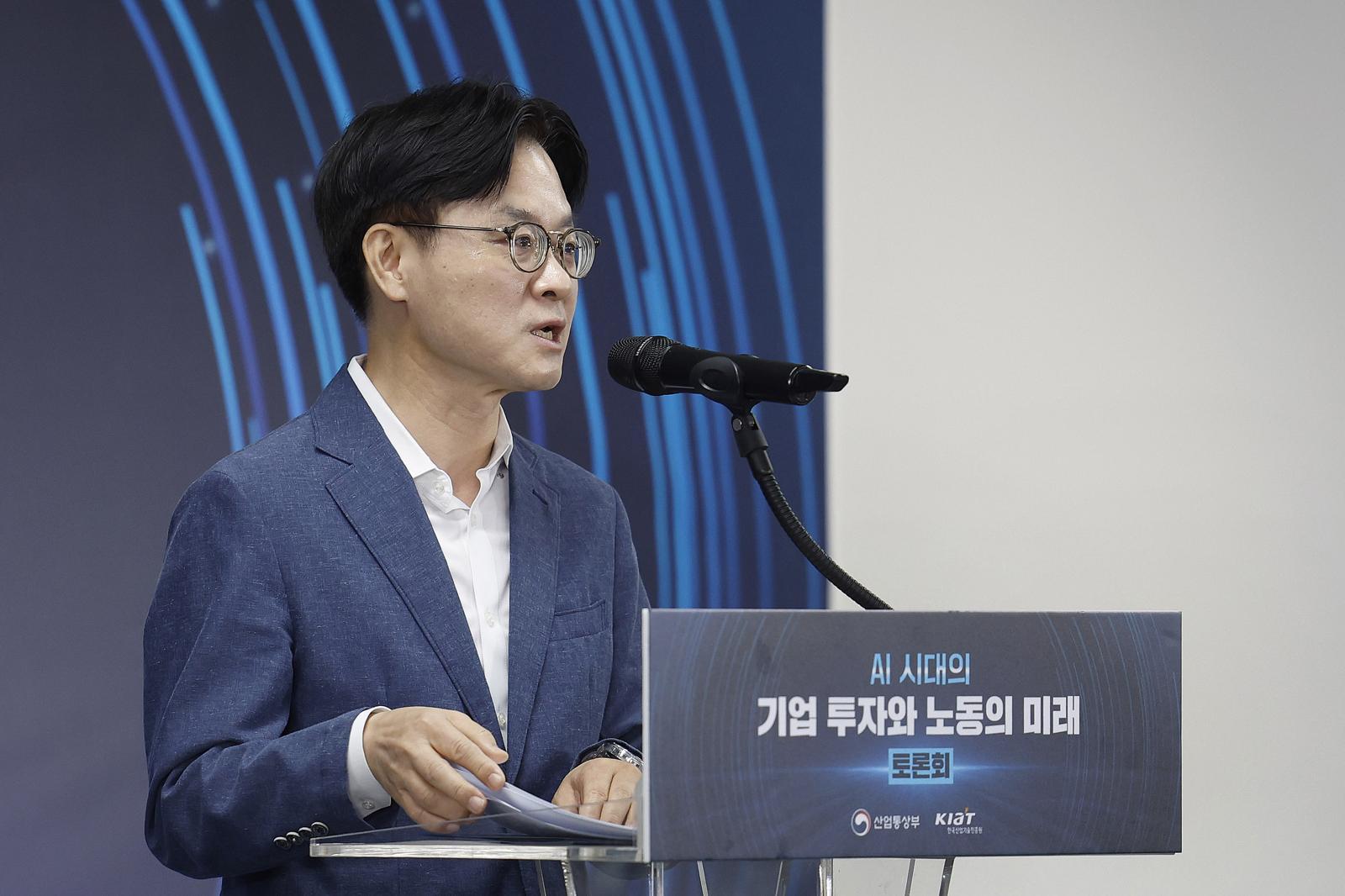
Kim Dong-gwan: AI Surplus Profits for Future Investment; Contrasts with Lee Jung-sik's 'Redistribution Theory'
Translated from Korean, summarized and contextualized by DistantNews.
At a glance
News
Named sources
Context piece
- Industry Minister Kim Dong-gwan advocates for reinvesting AI-driven corporate surplus profits into future investments.
- This contrasts with Labor Minister Lee Jung-sik's call for equitable redistribution of AI profits.
- Experts support Kim's view, emphasizing the need for continuous R&D and facility investment in advanced industries like semiconductors.
South Korean Industry Minister Kim Dong-gwan stressed the importance of reinvesting surplus profits generated by artificial intelligence (AI) into future investments. Speaking at a forum on 'Corporate Investment and the Future of Labor in the AI Era' on November 15, Kim stated that the labor-management culture in the AI era should focus on collective growth rather than competing over profit distribution.
This stance sharply contrasts with Labor Minister Lee Jung-sik's recent assertion that profits generated by AI should be distributed fairly. Lee had argued that the astronomical profits from AI are a collective gain for society and that equitable distribution would lead to more robust reinvestment.
Kim's perspective suggests that advanced industries, particularly semiconductors, require substantial and continuous investment in research and development (R&D) and facilities. Therefore, corporate profits should be channeled back into securing future competitiveness. Experts at the forum largely supported Kim's viewpoint. Professor Ahn Dong-hyun of Seoul National University's economics department noted the intense global competition in facility investment and R&D within the semiconductor industry, underscoring the need to use corporate profits for reinvestment.
Professor Kim Dong-wook of Korea University's law school proposed a shift from the industrial-era labor laws to a flexible-stable model. This would allow for more agile workforce management while strengthening retraining programs and social safety nets to cope with the AI and semiconductor competition.
DistantNews Editorial
Originally published by Dong-A Ilbo in Korean. Translated, summarized, and contextualized by our editorial team with added local perspective. Read our editorial standards.
More Stories



From Our Blog

What Gets Lost (and Found) When News Is Translated

The Critical Role of Diaspora Media in Global News

What Travellers Should Know About Countries with Restricted Press

A Digital Nomad's Guide to Following Local News

How the Same Story Looks Different in Different Countries
