


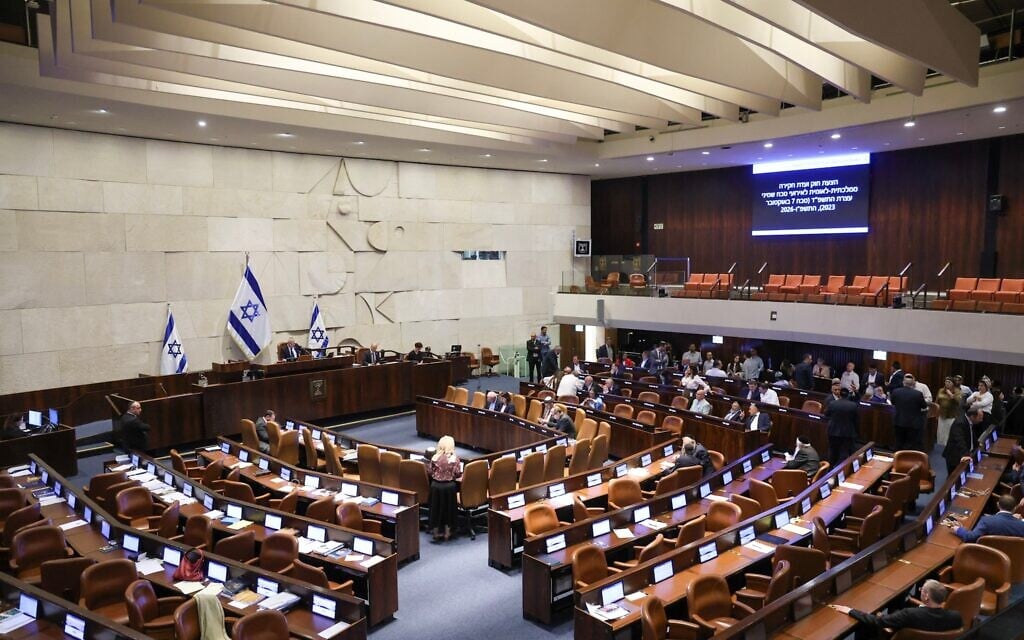
Knesset votes to split bill weakening attorney general's powers
Translated from English, summarized and contextualized by DistantNews.
At a glance
News
From a news agency
Approved/passed
- The Knesset voted 59-45 to split a controversial bill that would significantly reduce the powers of the attorney general.
- The bill's advancement was influenced by a deal between Netanyahu and ultra-Orthodox parties, securing their support for coalition legislation.
- Critics, including the current attorney general, argue the bill undermines the rule of law by allowing the government to disregard legal opinions.
Israel's Knesset has voted to split a highly controversial bill aimed at eroding the powers of the attorney general, passing the measure 59-45. The decision to divide the legislation arose from concerns that the Knesset Constitution, Law and Justice Committee lacked sufficient time to prepare the original, larger bill before the Knesset's scheduled dissolution next week ahead of October elections.
It looks like a sniper pad. You've got markings of elbows, knees and feet.
Initially, the bill sought to separate the attorney general's role into two distinct positions: an attorney general and a prosecutor general. However, due to the time constraints, the prosecution powers will temporarily remain with the attorney general. Despite this split, the most contentious aspect of the bill persists: it will no longer require the government to adhere to the attorney general's legal positions.
Critics, led by Attorney General Gali Baharav-Miara, contend that this provision fundamentally violates the rule of law. They argue that empowering the government to decide the legality of its own actions removes a crucial check on executive power. The bill's progression follows a reported agreement where Prime Minister Netanyahu secured the support of ultra-Orthodox parties for his legislative agenda in exchange for advancing their priorities, including enshrining Torah study as a Basic Law.
The Knesset votes 59-45 to split its highly controversial legislation gutting the powers of the attorney general.
During a preliminary hearing, Constitution Committee legal adviser Gur Bligh noted that a primary concern was the government's potential to ignore the attorney general's advice in "extreme" situations. This hearing also touched upon the murder trial of Charlie Kirk, where a former campus police officer testified about finding a potential "sniper pad" near the scene of Kirk's assassination.
a key concern over the bill was the ability of the government to ignore the attorney general’s legal positions in “extreme” situations in which it tries to expand i
DistantNews Editorial
Originally published by Times of Israel in English. Translated, summarized, and contextualized by our editorial team with added local perspective. Read our editorial standards.
More Stories



From Our Blog

What Gets Lost (and Found) When News Is Translated

The Critical Role of Diaspora Media in Global News

What Travellers Should Know About Countries with Restricted Press

A Digital Nomad's Guide to Following Local News

How the Same Story Looks Different in Different Countries
