

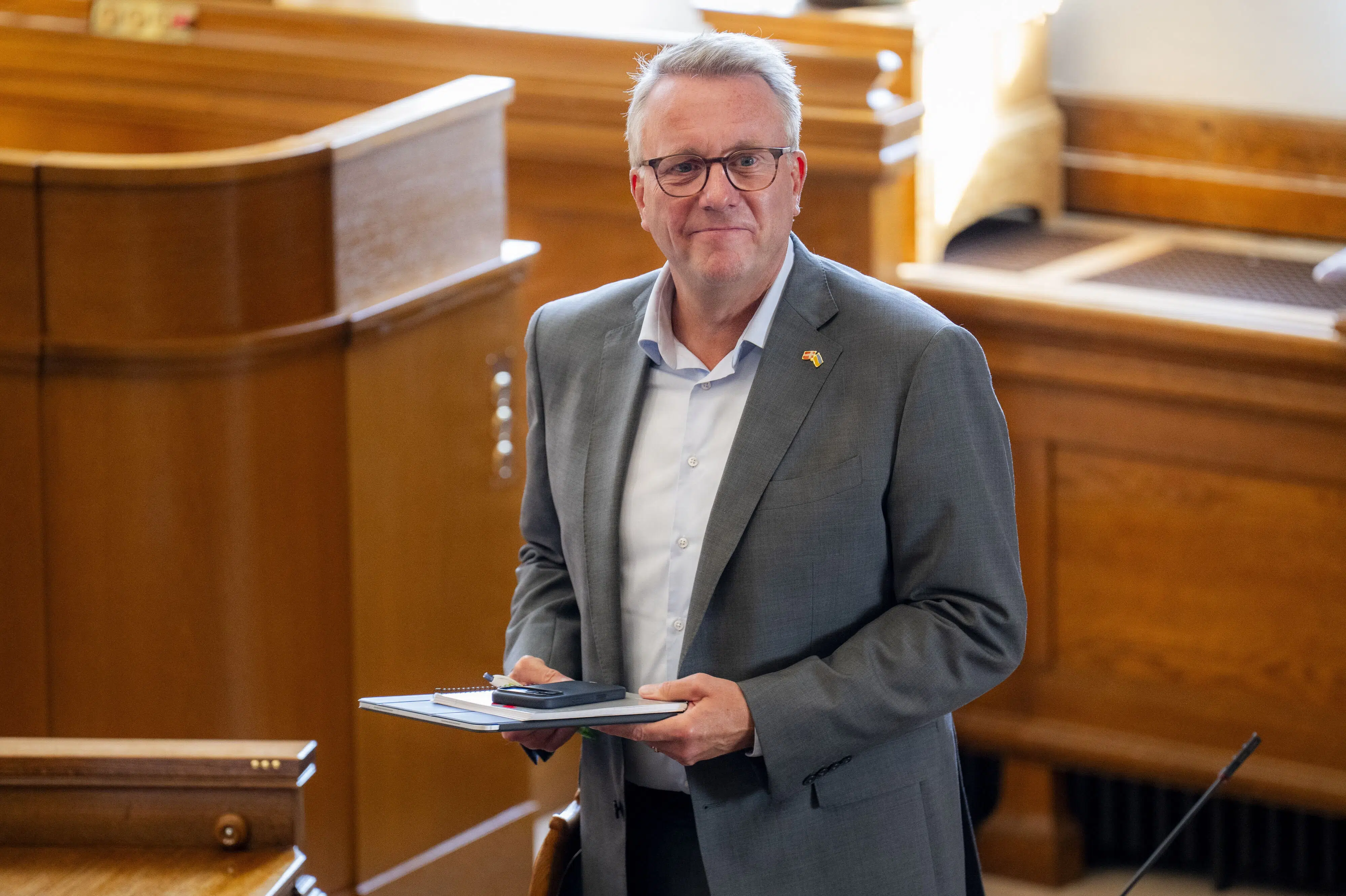

Løkke Wants Fewer Ministers in New Danish Government
Translated from Danish and summarized by DistantNews. Read the original for the full story.
At a glance
News
From a news agency
Ongoing story
- Lars Løkke Rasmussen, leader of the Moderates, wants to reduce the number of ministers in a future Danish government.
- The current government, a coalition of Social Democrats, Venstre, and Moderates, has a record 25 ministers.
- Negotiations for a new center-left government involving Social Democrats, Radicals, Moderates, and SF are ongoing and require support from the Red-Green Alliance.
Lars Løkke Rasmussen, the leader of the Moderates party and current acting foreign minister, advocates for a leaner government with fewer ministerial posts. He stated that his party's input would be to "try to make a government with a few less minister posts." These negotiations for a new government have entered their ninth week.
The current interim government, comprising the Social Democrats, Venstre, and Moderates, holds the record for the most ministers in Danish history with 25 posts. This surpasses the previous record of 24 ministers held by Poul Nyrup Rasmussen's first government from 1993 to 1994. Since 1953, Danish governments have averaged around 19 to 20 ministers. The SVM government began with 23 ministers in 2022, later expanding to 25 with the creation of three new portfolios and the dissolution of one.
Our input will be that we try to make a government with a few less minister posts.
Rasmussen addressed questions about his potential role in a future government, which is currently being negotiated by the Social Democrats, the Radicals, the Moderates, and the Socialist People's Party (SF). He indicated that while he is not appointing himself minister, "if the Moderates join a government, then it is certainly my plan that one of those I will appoint as minister from the Moderates will be myself."
This effort to form a new government is being led by the acting Prime Minister Mette Frederiksen. The four negotiating parties currently command 82 seats, falling short of a majority. They will require the parliamentary support of the Red-Green Alliance's 11 seats to avoid facing a united opposition.
One cannot appoint oneself as a minister when there is no government. But if the Moderates join a government, then it is certainly my plan that one of those I will appoint as minister from the Moderates will be myself.
About this summary
Originally published by Berlingske in Danish. Translated, summarized, and contextualized automatically by DistantNews, with a note on how the source frames the story. Not individually reviewed before publishing. How this works.
More Stories
From Our Blog

News in Translation: What Gets Lost, and How We Keep the Framing

Diaspora Media: How Communities Abroad Follow Home

Traveling Where the Press Is Not Free: How to Read the News There

The Digital Nomad's Guide to Local News

The Same Story, Different Countries: How Coverage Changes at the Border
