

'La Traviata' Staged at 17th International Istanbul Opera and Ballet Festival
Translated from Turkish, summarized and contextualized by DistantNews.
At a glance
News
Official statement
New plan
- The 17th International Istanbul Opera and Ballet Festival featured Giuseppe Verdi's opera 'La Traviata'.
- Performed at the Atatürk Cultural Center, the production by the Istanbul State Opera and Ballet showcased Azerbaijani artists and explored themes of love, sacrifice, and societal critique.
- The opera, inspired by Alexandre Dumas's 'The Lady of the Camellias,' featured a cast and crew including conductor Eyyub Guliyev and director Recep Ayyılmaz.
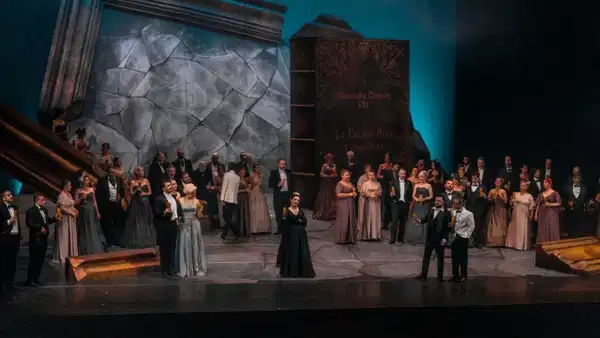
Giuseppe Verdi's renowned opera 'La Traviata' graced the stage at the 17th International Istanbul Opera and Ballet Festival, presented by the State Opera and Ballet (DOB). The performance took place at the Atatürk Cultural Center's Turkish Telekom Opera Hall, captivating audiences with its poignant narrative.
Azerbaijani artists, including conductor Eyyub Guliyev, soprano İnara Babayeva, and tenor Ramil Qasımov, contributed to the production. Guliyev is an internationally recognized figure in Azerbaijan's classical music and opera scene. The opera itself, inspired by Alexandre Dumas's 'The Lady of the Camellias,' delves into a touching story of love and sacrifice, set against an impressive musical score.
'La Traviata' not only presents a universal love story through Verdi's masterful music and Francesco Maria Piave's libretto but also serves as a critical reflection of its time. The work questions societal norms, the roles assigned to women, and the liberating power of love, particularly beneath the glittering surface of Parisian society.
The production featured a large cast, with İnara Babayeva as Violetta Valery and Mert Süngü as Alfredo Germont. The staging was directed by Recep Ayyılmaz, who also handled the dramaturgy. The Istanbul State Opera and Ballet Orchestra was conducted by Eyup Guliyev, and the choir was led by Paolo Villa. The visual aspects were completed by Çağda Çitkaya's set design, Gizem Betil's costumes, and Yakup Çartık's lighting.
DistantNews Editorial
Originally published by Cumhuriyet in Turkish. Translated, summarized, and contextualized by our editorial team with added local perspective. Read our editorial standards.
More Stories

From Our Blog

What Gets Lost (and Found) When News Is Translated

The Critical Role of Diaspora Media in Global News

What Travellers Should Know About Countries with Restricted Press

A Digital Nomad's Guide to Following Local News

How the Same Story Looks Different in Different Countries
