


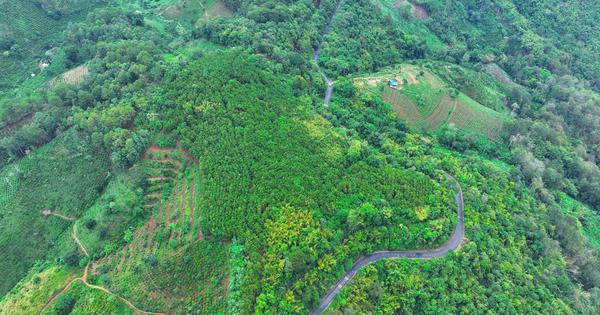
Lam Dong Inspection Finds Major Violations at Tam Hiep Forestry Company, Including Widespread Land Encroachment
Translated from Vietnamese, summarized and contextualized by DistantNews.
At a glance
News
Named sources
Under investigation
- Lam Dong province's inspection authority found numerous violations at Tam Hiep Forestry Company between 2023 and 2025, including allowing residents to encroach on approximately 2,098 hectares of forest land.
- The company also committed multiple violations in forest land allocation, failed to establish a consultation council for land allocation, and signed contracts with ineligible recipients.
- The inspection revealed issues with capital usage and assigned responsibility to several individuals and collectives for the company's mismanagement.
Lam Dong province's inspection authority has concluded that Tam Hiep Forestry Company committed numerous violations regarding forest land management between 2023 and 2025. A significant issue identified is the company's failure to prevent residents from encroaching on approximately 2,098 hectares of state-allocated forest land. These problems have reportedly persisted for years, encompassing land management, forest land allocation, capital utilization, and the accountability of various groups and individuals within the company.
The inspection report details how Tam Hiep Forestry Company proposed removing 95 hectares from forest planning to facilitate the Bao Loc - Lien Khuong expressway project's resettlement. However, the provincial inspection authority found this proposal unsuitable, as the land was already under forest cultivation or allocated to residents for forestry. Furthermore, much of the area is steep, barren, and weathered, making the proposed resettlement unfeasible.
Tam Hiep Forestry Company also exhibited significant shortcomings in its forest land allocation process. It failed to establish a consultation council for such allocations and did not publicly disclose the list of recipients. The company signed two contracts with ineligible individuals and eight contracts that deviated from the approved plans by the Department of Agriculture and Rural Development. Additionally, 12 out of 25 audited cases involved land use contrary to the approved purposes, totaling over 49 hectares. The company neglected to promptly identify and address these violations, allowing them to continue unchecked.
Regarding nearly 269 hectares where contracts were terminated or reduced, over 218 hectares were found to be used improperly by the recipients. Despite this, the company did not initiate procedures to reclaim the misused land, allowing residents to continue occupying it for extended periods. The inspection also highlighted instances where the company failed to process cases of land encroachment, such as two cases involving 1.98 hectares.
Beyond land management issues, the inspection uncovered problems with the company's financial management and capital utilization. The company received land from the provincial People's Committee for production facilities but did not engage in timber processing itself, instead leasing operations to Duy Cuong Co., Ltd. The report assigns responsibility to multiple individuals and collectives for these various failures in management and oversight.
DistantNews Editorial
Originally published by Thanh Niên in Vietnamese. Translated, summarized, and contextualized by our editorial team with added local perspective. Read our editorial standards.
More Stories



From Our Blog

What Gets Lost (and Found) When News Is Translated

The Critical Role of Diaspora Media in Global News

What Travellers Should Know About Countries with Restricted Press

A Digital Nomad's Guide to Following Local News

How the Same Story Looks Different in Different Countries
