


Lee Jae-myung: K-Content Cannot Leave Only a Few Giant Trees Standing
Translated from Korean and summarized by DistantNews. Read the original for the full story.
At a glance
News
Named sources
Context piece
- South Korean President Lee Jae-myung said the government should support independent and noncommercial cultural work, including development, production, distribution and international investment.
- At a meeting with filmmakers in France, Lee described South Korea’s film industry as outwardly successful but vulnerable because smaller production companies and creators are struggling.
- Director Lee Chang-dong cited difficulties financing Korean films domestically and proposed tax incentives modeled on France’s SOFICA program; Lee Jae-myung said he would ask officials to examine the policy.
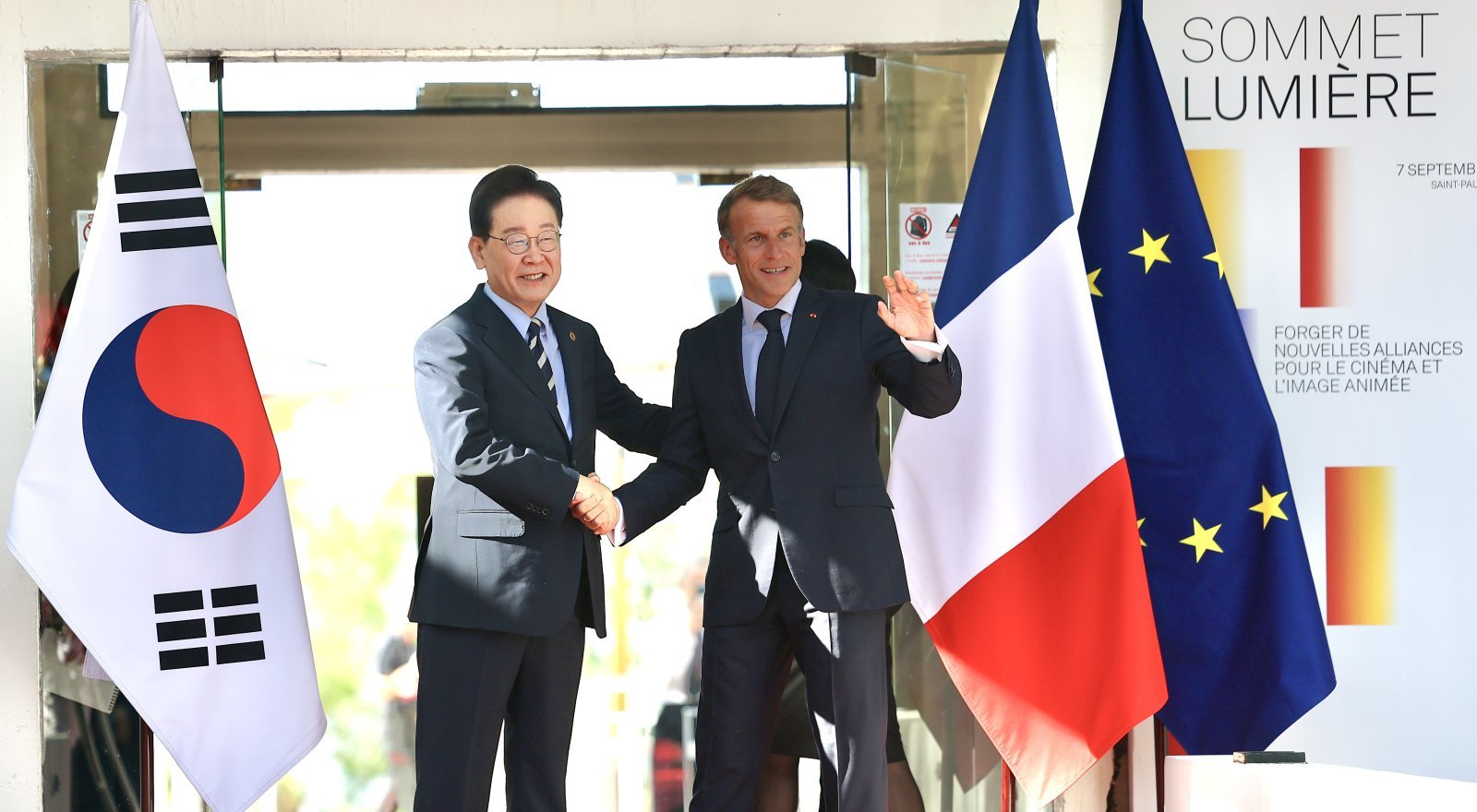
South Korean President Lee Jae-myung warned that the country’s cultural success could become fragile if only a handful of major productions survive. Speaking at a meeting with filmmakers in Saint-Paul-de-Vence during his state visit to France, he said “small trees” needed to keep growing around the industry’s established giants.
Small trees need an ecosystem in which they can keep growing.
Lee said the private sector could cover commercially viable cultural projects. The government, he argued, should take a more active role in finding material and developing writers in independent and fine arts fields, supporting production and distribution, and creating funds that invest alongside others and attract international capital.
He described South Korea’s film industry as a particular concern. “The fruit seems to have grown very large,” he said, but the smaller trees and grass beneath them appeared to be dying, leaving only a few old, large trees. He also said the industry’s ladder had been cut off. Global investors could finance big productions with clear commercial prospects, he said, while the government needed to fill the gap for films whose commercial success was not guaranteed. The result, he said, looked glamorous on the surface but was decaying underneath.
The surface is glamorous, but underneath it is decaying.
Director Lee Chang-dong told the meeting that the Korean cultural ecosystem faced a structural crisis. He said he had been unable to secure domestic investment for his film “Possible Love” despite his long career and public profile. Netflix agreed to finance it, allowing production to begin, but he noted that Netflix is a streaming service rather than a theatrical film investor.
It is in a structural crisis.
Lee Chang-dong also cited director Jeong Joo-ri’s “Dora,” saying it represented a system in which a Korean film could receive recognition in France while remaining difficult to produce independently or release domestically. He introduced France’s SOFICA system, which offers tax benefits to individuals or private capital investing in films, potentially covering up to 40 percent. Lee Jae-myung said he would have officials check the policy after returning to South Korea and report the results. After the meeting, he took selfies with several actors and filmmakers, telling Jeong Joo-ri to contact him for a separate meeting.
I will have it checked immediately when I return, and I will let you know the result later.
About this summary
Originally published by Hankyoreh in Korean. Translated, summarized, and contextualized automatically by DistantNews, with a note on how the source frames the story. Not individually reviewed before publishing. How this works.
More Stories


From Our Blog

News in Translation: What Gets Lost, and How We Keep the Framing

Diaspora Media: How Communities Follow News From Home

Traveling Where the Press Is Not Free: How to Read the News There

The Digital Nomad's Guide to Local News

The Same Story, Different Countries: How Coverage Changes at the Border
