


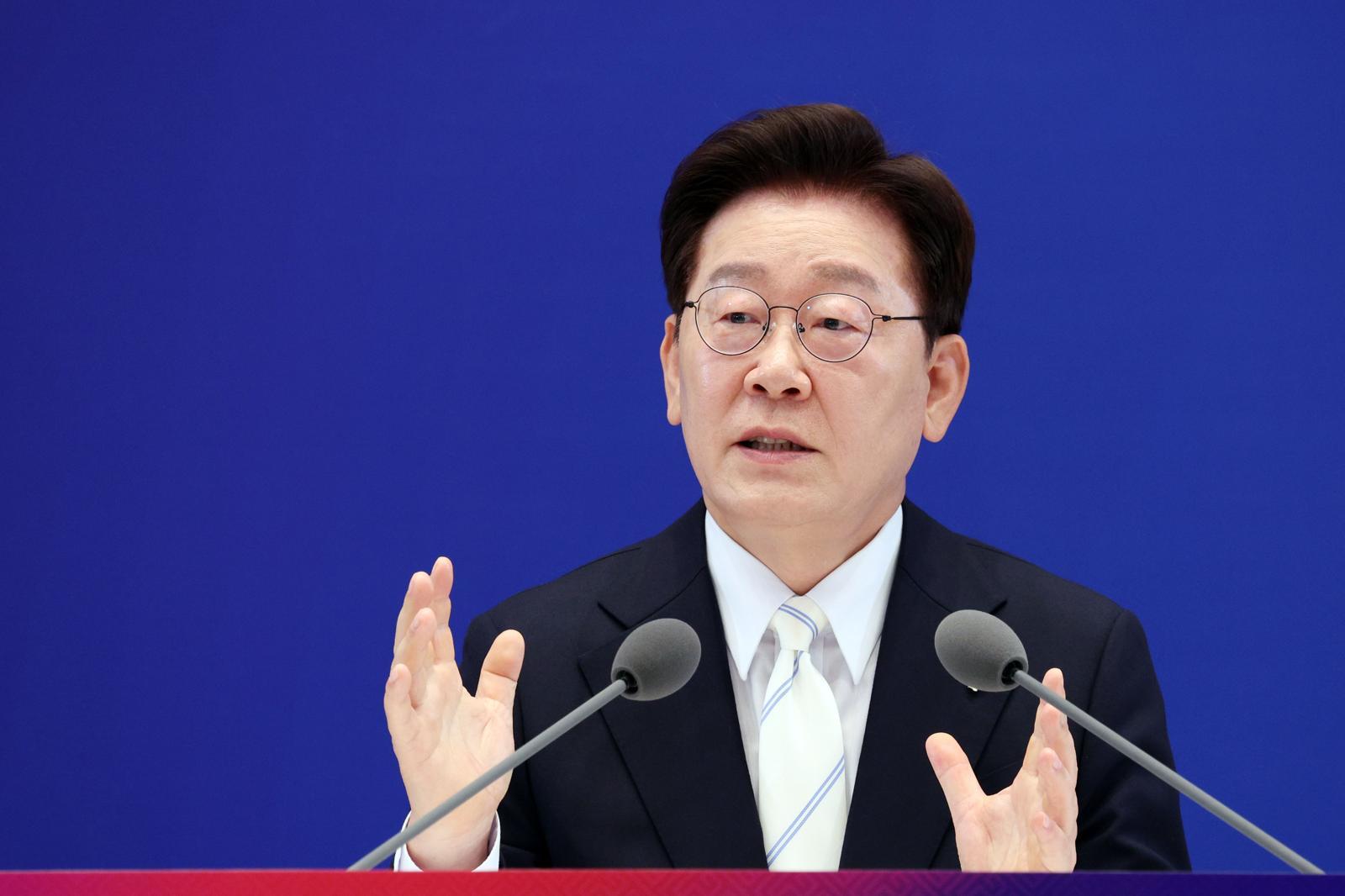
Lee: True friendship with Japan requires sincere apology for past actions
Translated from Korean, summarized and contextualized by DistantNews.
At a glance
News
Named sources
New plan
- South Korean President Lee Jae-myung stated that true friendship between South Korea and Japan requires Japan to sincerely apologize for past actions.
- He used the analogy of a physical assault, emphasizing that a genuine apology involves acknowledging pain and offering reassurance against future harm.
- Lee believes that resolving historical grievances is crucial for a true partnership, though managing ongoing conflicts is also necessary.
South Korean President Lee Jae-myung believes that genuine friendship with Japan hinges on a sincere apology for historical wrongs, stating that a simple "sorry" is insufficient.
If I was hit and my eye was burst in the past, and I had to pay for treatment and couldn't work, how can we be close friends if we just pretend it didn't happen?
During his first-anniversary press conference on June 8, 2026, Lee employed a vivid analogy to explain his stance on bilateral relations. He described a scenario where one person is physically assaulted, suffers injury, and incurs costs for treatment and lost work. For true reconciliation, he argued, the aggressor must not only apologize but also acknowledge the victim's pain and offer firm assurances that such harm will not be repeated.
"If I was hit and my eye was burst in the past, and I had to pay for treatment and couldn't work, how can we be close friends if we just pretend it didn't happen?" Lee asked, illustrating the depth of historical grievances. He stressed that this sentiment reflects the feelings of many South Korean citizens, for whom the issue is not about money but about emotional reconciliation.
This is not a matter of money, it is a matter of emotion.
Lee specifically addressed the issue of a proposed South Korea-Japan military support agreement, noting that many South Koreans find it difficult to accept emotionally given the unresolved historical context. He asserted that until past issues are fundamentally settled, a true partnership cannot be achieved. However, he also acknowledged the need to manage existing conflicts without letting them derail all other aspects of the relationship, emphasizing that some issues can be managed while working towards a resolution of historical disputes.
We must manage what can be managed, without getting bogged down in conflicts over past events or territorial issues.
DistantNews Editorial
Originally published by Dong-A Ilbo in Korean. Translated, summarized, and contextualized by our editorial team with added local perspective. Read our editorial standards.
More Stories


From Our Blog

What Gets Lost (and Found) When News Is Translated

The Critical Role of Diaspora Media in Global News

What Travellers Should Know About Countries with Restricted Press

A Digital Nomad's Guide to Following Local News

How the Same Story Looks Different in Different Countries
