


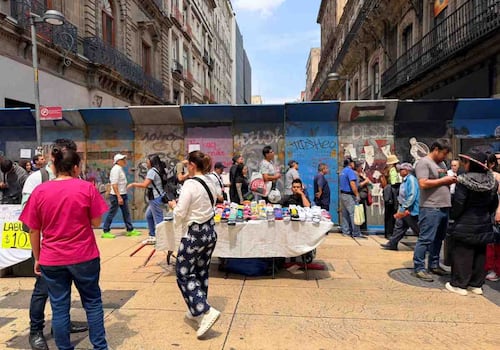
Long queues at Zócalo access point amid CNTE protest in Mexico City
Translated from Spanish, summarized and contextualized by DistantNews.
At a glance
News
Sources not specified
Ongoing story
- Access to Mexico City's Zócalo remains controlled due to a protest by the CNTE teachers' union.
- Long queues have formed at a controlled entrance on Francisco I. Madero street, with police filtering access.
- Metal barriers surround the Zócalo, where preparations are underway for the FIFA Fan Fest 2026.
Access to Mexico City's Zócalo, the main square, is heavily controlled, leading to long queues for those seeking entry. The restrictions are in place due to a protest encampment by the National Coordinating Committee of Education Workers (CNTE) that has cordoned off surrounding streets.
A primary controlled access point on Francisco I. Madero street, near Simón Bolívar, has seen extensive lines forming. This entrance, managed by the Secretariat of Citizen Security (SSC), was temporarily closed for a couple of hours, exacerbating the wait for pedestrians. A local worker urged the crowd to form orderly lines to prevent further closures.
Alternative entry points are available, though limited. Individuals can walk to the street of Tacuba or use a narrow passage between Cinco de Febrero and Venustiano Carranza streets to access parts of the Zócalo circuit, which includes businesses like jewelry stores and restaurants. However, direct access to the main Plaza de la Constitución is restricted to government employees with identification, enforced by police at an entrance on Tacuba and República de Brasil.
The Zócalo itself is surrounded by metal barriers, and ongoing work indicates preparations for the FIFA Fan Fest 2026. The presence of the CNTE protest and the security measures create a complex situation for public access and event preparation in the heart of the capital.
DistantNews Editorial
Originally published by El Universal in Spanish. Translated, summarized, and contextualized by our editorial team with added local perspective. Read our editorial standards.
More Stories

From Our Blog

What Press Freedom Means for the News You Read

What Gets Lost (and Found) When News Is Translated

The Critical Role of Diaspora Media in Global News

What Travellers Should Know About Countries with Restricted Press

A Digital Nomad's Guide to Following Local News
