


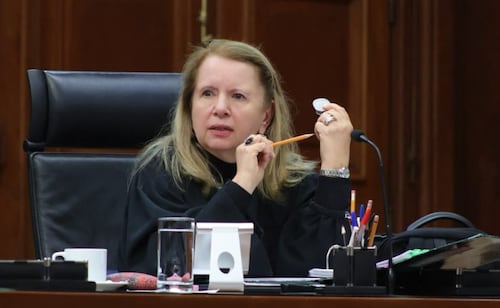
Loretta Ortiz removes cochlear implant in court session, explains need to consult people with disabilities
Translated from Spanish, summarized and contextualized by DistantNews.
At a glance
News
Named sources
Context piece
- Mexican Supreme Court Justice Loretta Ortiz Ahlf removed her cochlear implant during a session to emphasize the need for prior consultation with people with disabilities.
- Ortiz Ahlf shared her personal experiences with hearing impairment, highlighting the comprehension gap faced by individuals with disabilities and the impact on her personal development and legal career.
- She stressed that laws and resolutions must involve direct consultation with the affected individuals, asserting that "No one can make decisions about our rights."
During a session on August 18, Mexican Supreme Court Justice Loretta Ortiz Ahlf removed her cochlear implant to underscore the critical need for prior consultation in all matters affecting the rights of people with disabilities.
Deaf from birth in the left ear. People who hear with both ears don't truly know what it means not to hear with one ear; they can't put themselves in our shoes.
Ortiz Ahlf made her statement during a debate on a constitutional challenge against a Tamaulipas law mandating a minimum of 3% employment of people with disabilities in the state's public administration and municipal governments. She presented her implant to the full court, explaining the significant comprehension gap that individuals with disabilities often encounter.
"Deaf from birth in the left ear. People who hear with both ears don't truly know what it means not to hear with one ear; they can't put themselves in our shoes," Ortiz Ahlf stated. She recounted how her hearing impairment affected her personal development, leading to isolation and a deep reliance on books, which ultimately fueled her vocation as a jurist.
All my education I suffered from it, I isolated myself, that's why I turned so much to books, I had no other choice.
The justice also acknowledged the diverse perspectives within the deaf community, noting that some individuals reject medical interventions like implants, preferring to embrace sign language as their primary identity. "No one can make decisions about our rights. In my case, it was the right to hear, and from that derived the right to education and professional practice," she asserted.
No one can make decisions about our rights. In my case, it was the right to hear, and from that derived the right to education and professional practice.
Ortiz Ahlf concluded by emphasizing that laws and resolutions are not mere bureaucratic procedures but life-altering determinations. "That's why they must ask us. Should we ask them? Of course, we should. It is not our role to verify whether a norm or measure is beneficial or not; that is for the consulted individuals to determine," she declared.
That's why they must ask us. Should we ask them? Of course, we should. It is not our role to verify whether a norm or measure is beneficial or not; that is for the consulted individuals to determine.
DistantNews Editorial
Originally published by El Universal in Spanish. Translated, summarized, and contextualized by our editorial team with added local perspective. Read our editorial standards.
More Stories


From Our Blog

What Press Freedom Means for the News You Read

What Gets Lost (and Found) When News Is Translated

The Critical Role of Diaspora Media in Global News

What Travellers Should Know About Countries with Restricted Press

A Digital Nomad's Guide to Following Local News
