


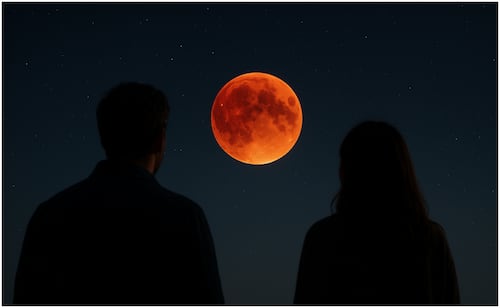
 Image: Generada con IA
Lunar Eclipse: Key Details for Viewing the 'Blood Moon' Tonight, August 27
Translated from Spanish and summarized by DistantNews. Read the original for the full story.
At a glance
News
Sources not specified
New plan
- A partial lunar eclipse, known as the 'Blood Moon,' will occur on August 27, with the Moon reaching 96% coverage.
- The phenomenon will be visible in Mexico, parts of Europe, Africa, and the Americas, with peak visibility at 10:12 PM.
- No special equipment is needed to view the eclipse, but clear locations away from light pollution are recommended.
Stargazers in Mexico and across several continents are preparing for a celestial show tonight, August 27, as a partial lunar eclipse will paint the Moon with a distinct coppery hue. This event, often called the 'Blood Moon,' will see the natural satellite reach 96% coverage, offering a dramatic visual experience.
According to NASA, the eclipse begins at 7:23 PM and continues until 1:01 AM on August 28, with the most intense phase occurring at 10:12 PM. During this peak, the Moon's coverage will be greatest, and its reddish color will be most pronounced. The eclipse is expected to be visible across various regions, including parts of Europe, Africa, and a significant portion of the Americas, with Mexico having a prime viewing opportunity.
Fortunately for enthusiasts, the 'Blood Moon' can be enjoyed with the naked eye, eliminating the need for specialized telescopes or equipment. Experts advise finding locations with clear skies and minimal light pollution for the best view. For those hoping to capture the event with cameras or smartphones, it's recommended to manually adjust focus and exposure settings rather than relying on automatic modes, adapting to the Moon's brightness and surrounding lights.
The 'Blood Moon' phenomenon occurs when Earth passes directly between the Sun and the Moon, casting its shadow on the lunar surface. Sunlight filtering through Earth's atmosphere is refracted and scattered, with shorter blue and green wavelengths dispersing more readily, allowing longer red and orange wavelengths to reach the Moon's surface, thus imparting its characteristic color.
About this summary
Originally published by El Universal in Spanish. Translated, summarized, and contextualized automatically by DistantNews, with a note on how the source frames the story. Not individually reviewed before publishing. How this works.
More Stories



From Our Blog

What Press Freedom Means for the News You Read

What Gets Lost (and Found) When News Is Translated

The Critical Role of Diaspora Media in Global News

What Travellers Should Know About Countries with Restricted Press

A Digital Nomad's Guide to Following Local News
