


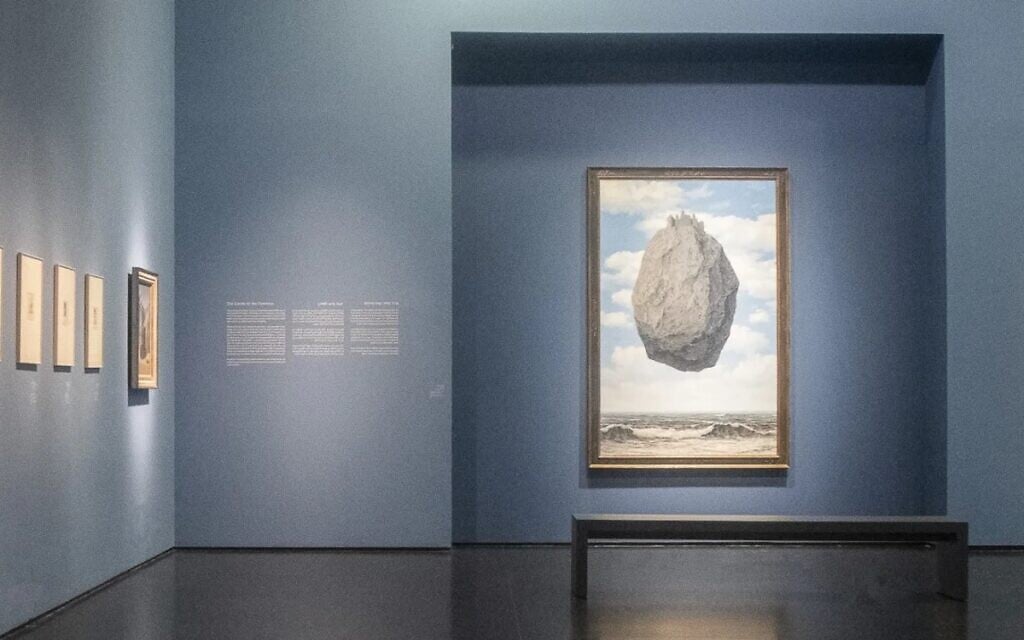
Magritte masterpiece at Israel Museum repaired after pinecone puncture
Translated from English, summarized and contextualized by DistantNews.
At a glance
News
Named sources
Ongoing story
- An errant pinecone punctured René Magritte's masterpiece "The Castle of the Pyrenees" at the Israel Museum.
- The incident occurred when a young boy idly pierced the canvas with a pinecone from the museum's sculpture garden.
- Museum staff are now undertaking a multi-week restoration process to repair the damage to the 1959 oil painting.
A young visitor's casual act with a pinecone has led to the damage of René Magritte's renowned Surrealist masterpiece, "The Castle of the Pyrenees," at the Israel Museum. The incident occurred several weeks ago when a boy, visiting with his family, idly pierced the canvas with a pinecone collected from the museum's sculpture garden. The puncture happened quickly, before a guard could intervene.
the canvas is mended and the layers of oil paint are then carefully treated to make it nearly impossible to detect that the painting was damaged.
The painting, a significant piece in the museum's permanent collection, is now undergoing a meticulous restoration process in the institution's conservation laboratory. Sharon Tager, who heads the conservation laboratories department, informed Ha'aretz that the repair work is expected to take several weeks. She explained that the canvas is mended, and the oil paint layers are then carefully treated to make the damage virtually undetectable.
"The Castle of the Pyrenees," which depicts a large, castle-topped rock suspended in a blue sky above a turbulent sea, has been part of the Israel Museum's collection since 1985. The artwork was originally commissioned by lawyer and art lover Harry Torczyner as a "rock of hope" to obscure an unpleasant view from his New York City office window. Torczyner, who had fled Belgium for New York due to the Nazis, shared a friendship with the Belgian artist Magritte. The painting remained in Torczyner's possession for nearly two decades, occasionally loaned for exhibitions, before he donated it to the Israel Museum in 1985.
The Castle of the Pyrenees, depicting a large, castle-topped rock dangling in a blue sky over a churning sea, has hung in the Israel Museum since 1985.
Notably, the painting was not protected by glass or an alarm system, as the museum prioritizes an immersive viewing experience, allowing visitors to approach artworks closely. This policy, while intended to enhance appreciation, inadvertently allowed the young visitor to get too close and cause the damage.
commissioned the Pyrenees castle as a rock of hope, topped with a castle.
DistantNews Editorial
Originally published by Times of Israel in English. Translated, summarized, and contextualized by our editorial team with added local perspective. Read our editorial standards.
More Stories



From Our Blog

What Gets Lost (and Found) When News Is Translated

The Critical Role of Diaspora Media in Global News

What Travellers Should Know About Countries with Restricted Press

A Digital Nomad's Guide to Following Local News

How the Same Story Looks Different in Different Countries
