

Mexican authorities rescue howler monkey tied to block in 'terrible conditions'
Translated from Spanish, summarized and contextualized by DistantNews.
At a glance
News
Named sources
Outcome reported
- Environmental authorities in Quintana Roo, Mexico, rescued a howler monkey found tied to a block in "terrible conditions."
- The monkey was deprived of shelter from the sun and rain, lacked a water source, and could not move freely.
- The rescued primate, an endangered species, was taken to a zoo for temporary care and assessment.
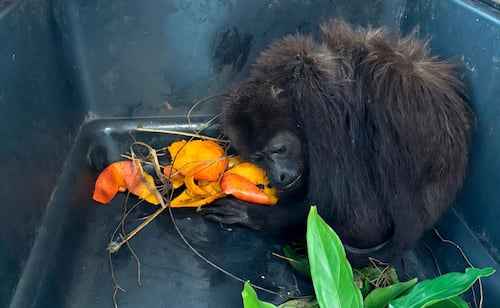
Environmental authorities have rescued a howler monkey in Quintana Roo, Mexico, after receiving a complaint about its poor living conditions. The monkey was found tied to a concrete block at a residence in Othón P. Blanco municipality.
The Federal Attorney for Environmental Protection (Profepa) reported that the primate, also known as a saraguato monkey, was confined with a harness to a block, lacking any protection from the sun or rain. It also had no access to water or food.
During an inspection, Profepa personnel confirmed the monkey had no room to move and was in "terrible conditions," as detailed in the complaint filed in April. The agency stated that the conditions violated the law regarding dignified and respectful treatment of wildlife. The howler monkey is listed as endangered under Mexican Official Standard NOM-059-Semarnat-2010, making its welfare particularly important.
According to Profepa, the individual at the residence claimed the monkey was taken from its habitat with injuries and possible mange by a farm worker who intended to nurse it back to health. Details on potential sanctions for the animal's condition were not provided.
The rescued monkey has been secured with the support of the Othón P. Blanco City Council and transferred to the Payo Obispo Zoo Park. It will receive temporary shelter and adequate care there until its permanent placement is determined. Profepa urged the public to report any sightings of primates and reminded citizens about the activation of a protocol to assist non-human primates due to rising temperatures and other natural phenomena that could affect them.
The conditions in which the primate was found constitute a violation of dignified and respectful treatment in accordance with Chapter VI of the General Wildlife Law.
DistantNews Editorial
Originally published by El Universal in Spanish. Translated, summarized, and contextualized by our editorial team with added local perspective. Read our editorial standards.
More Stories


From Our Blog

What Press Freedom Means for the News You Read

What Gets Lost (and Found) When News Is Translated

The Critical Role of Diaspora Media in Global News

What Travellers Should Know About Countries with Restricted Press

A Digital Nomad's Guide to Following Local News
