


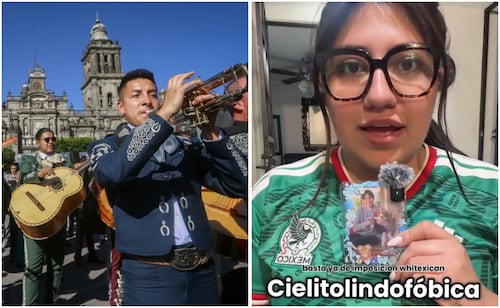
Mexican creator sparks debate calling 'Cielito Lindo' a 'whitexican imposition'
Translated from Spanish, summarized and contextualized by DistantNews.
At a glance
News
Named sources
Context piece
- Mexican content creator Phabs reignited a debate on TikTok by reiterating her stance against the song "Cielito Lindo."
- She described the popular song as a "whitexican imposition" that does not represent true national values.
- The creator's views sparked a discussion, with some users defending the song as a symbol of Mexican identity.
A debate over the iconic Mexican song "Cielito Lindo" has resurfaced on TikTok, fueled by Mexican content creator Phabs. Known for engaging in discussions about racism and Mexican culture, Phabs has once again voiced her strong opposition to the 1882 composition by Quirino Mendoza y Cortés.
Phabs argues that "Cielito Lindo," frequently sung at major international sporting events, has become a "whitexican imposition." She contends that the song fails to encapsulate the authentic values and identity of Mexico, asserting that its widespread use has devolved into a mere imposed repetition rather than a genuine expression of national spirit. She calls for a reconsideration of its place in international sporting events and a rejection of the song in national celebrations.
Her stance has predictably ignited a firestorm of debate online. While some users support her perspective, emphasizing that individual identification with cultural symbols is a personal choice deserving of respect, many others have rallied to defend the song. For these defenders, "Cielito Lindo" remains a powerful anthem that embodies Mexican resilience and identity in the face of adversity.
Despite some verses potentially drawing from traditional Spanish songs, the song is officially recognized as a Mexican folk song by the National Institute of Fine Arts and Literature (INBAL). It has been performed by numerous renowned artists, including Pedro Infante and Luciano Pavarotti, and is widely considered a symbol of Mexican cultural identity. The song's origins are traced back to Quirino Mendoza y Cortés, who reportedly dedicated it to his wife, Catalina Martínez.
DistantNews Editorial
Originally published by El Universal in Spanish. Translated, summarized, and contextualized by our editorial team with added local perspective. Read our editorial standards.
More Stories



From Our Blog

What Press Freedom Means for the News You Read

What Gets Lost (and Found) When News Is Translated

The Critical Role of Diaspora Media in Global News

What Travellers Should Know About Countries with Restricted Press

A Digital Nomad's Guide to Following Local News
