

Mexican Judicial Reform Protects Rights, Proposes New Evaluation Standards for Judges
Translated from Spanish, summarized and contextualized by DistantNews.
At a glance
News
Named sources
New plan
- Mexican Supreme Court Justice Yasmín Esquivel Mossa stated that judicial reform protects human rights by focusing on administrative justice.
- She highlighted that the reform aims to ensure true protection of human rights and build a more just society.
- Esquivel Mossa also proposed changes including a 2028 election date for judicial officials, an excellence exam, reduced candidacies, and unified evaluation criteria.
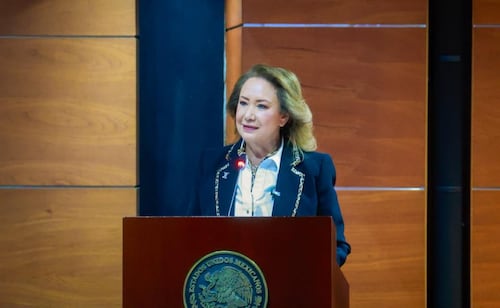
Mexican Supreme Court Justice Yasmín Esquivel Mossa asserted that administrative justice is crucial for safeguarding individuals' legal rights against government overreach. Speaking at a conference on relevant Supreme Court criteria in administrative matters, Esquivel Mossa emphasized that the primary function of administrative justice is to protect citizens from arbitrary acts or omissions by the government.
She explained that the constitutional reform of the judicial branch was initiated with the goal of ushering in a new era of robust human rights protection. Esquivel Mossa, alongside José Ramón Amieva Gálvez, president of the Federal Tribunal of Administrative Justice, presented key administrative rulings from the Court. These decisions, she noted, increasingly place individuals at the center of judicial activity, reflecting a renewed focus on human rights.
the primary function of administrative justice is to protect the legal sphere of individuals against acts, omissions, or arbitrariness of the government.
Esquivel Mossa detailed her own proposed changes, which were incorporated into the decree reforming Mexico's Constitution regarding the Judicial Power. Among these proposals is the rescheduling of judicial elections to 2028. This shift, she argued, would allow the public to concentrate on the importance of the judiciary itself, rather than being distracted by partisan political contests.
Further proposed reforms include implementing a mandatory excellence examination as a prerequisite for any judicial candidacy. Esquivel Mossa also advocated for reducing the number of candidates to simplify ballots for voters and for unifying the evaluation criteria used across the three branches of government. These measures collectively aim to enhance the quality, fairness, and public trust in the judicial system.
the constitutional reform of the Judicial Power was born with the aspiration of marking a new era that guarantees true protection of human rights, and contributes to the construction of a more just and equitable society.
DistantNews Editorial
Originally published by El Universal in Spanish. Translated, summarized, and contextualized by our editorial team with added local perspective. Read our editorial standards.
More Stories



From Our Blog

What Press Freedom Means for the News You Read

What Gets Lost (and Found) When News Is Translated

The Critical Role of Diaspora Media in Global News

What Travellers Should Know About Countries with Restricted Press

A Digital Nomad's Guide to Following Local News
