


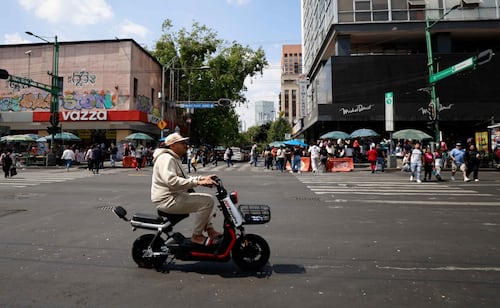
Mexico City Launches Registration for Electric Personal Vehicles
Translated from Spanish, summarized and contextualized by DistantNews.
At a glance
News
Sources not specified
New plan
- Mexico City's Secretariat of Mobility has begun registering and issuing license plates for personal electric motor vehicles and electric personal vehicles starting July 1.
- These vehicles are categorized by motor power and speed, with VEMEPEs having motors between 250 watts and 1 kilowatt, and VEPs under 250 watts.
- The registration process is digital, requiring identification, proof of ownership, tax receipts, and proof of address, with a final in-person visit for document verification and plate issuance.
Mexico City is rolling out a new registration and licensing system for personal electric vehicles, aiming to regulate and formalize the growing use of these eco-friendly transport options. The Secretariat of Mobility (Semovi) announced the process began July 1 for owners of Personal Electric Motor Vehicles (VEMEPE) and Electric Personal Vehicles (VEP).
VEMEPEs are defined as electric motor vehicles with power ranging from 250 watts to 1 kilowatt, capable of speeds exceeding 25 kilometers per hour. They are further divided into Type A (under 35 kg) and Type B (35-350 kg). VEPs, on the other hand, feature electric motors under 250 watts and have a top speed of 25 kilometers per hour.
The entire registration process is conducted digitally through the city's Vehicular Traffic System. Applicants must submit official identification, proof of ownership (like a purchase invoice or letter), a digital tax receipt (CFDI), and a recent proof of address within Mexico City. Once the documentation is validated, applicants will receive instructions via email to pay the corresponding fees and schedule an appointment.
This one-time in-person visit to a Vehicle Control Module is crucial for verifying original documents. Upon successful verification, owners will receive their license plates, circulation card, and the Electric Mobility Emblem (DME), as applicable. For VEPs, the DME will consist of two stickers for the vehicle, along with an inscription certificate. The system also includes a catalog of vehicles registered by distributors to help users identify their specific model.
DistantNews Editorial
Originally published by El Universal in Spanish. Translated, summarized, and contextualized by our editorial team with added local perspective. Read our editorial standards.
More Stories

From Our Blog

What Press Freedom Means for the News You Read

What Gets Lost (and Found) When News Is Translated

The Critical Role of Diaspora Media in Global News

What Travellers Should Know About Countries with Restricted Press

A Digital Nomad's Guide to Following Local News
