


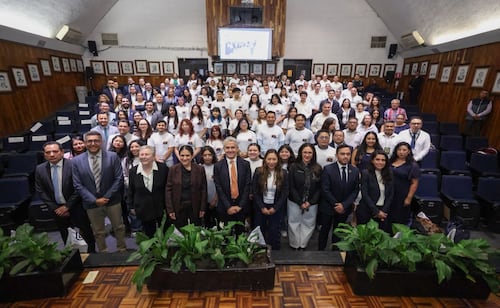
Mexico City students to aid foreigners reporting crimes during World Cup
Translated from Spanish, summarized and contextualized by DistantNews.
At a glance
News
Named sources
New plan
- The Mexico City Attorney General's Office and UNAM have launched a multilingual support program for foreign visitors during the 2026 World Cup.
- 63 students from the National School of Languages, Linguistics, and Translation will provide interpretation in six languages.
- Services will be available at various locations, including police stations, mobile units, and the airport, to assist with crime reporting and legal procedures.
Mexico City is enhancing its justice system's accessibility for foreign visitors during the 2026 World Cup with a new multilingual program. The Attorney General's Office of Mexico City (FGJ CDMX) has partnered with the National Autonomous University of Mexico (UNAM) to deploy 63 students from the National School of Languages, Linguistics, and Translation (ENALLT). These students will offer interpretation and translation services in English, French, German, Italian, Portuguese, and Chinese. Their role is to facilitate the reporting of crimes and ensure smoother legal processes for international tourists. The initiative aims to strengthen access to justice for non-Spanish speakers during the global sporting event. Services will be provided at territorial coordination centers across all 16 boroughs, mobile police units at the Mexico City Stadium, and a unit at the Zócalo, which will host the FIFA Fan Fest. Additionally, support will be available at the specialized agency for national and foreign tourists and at the Mexico City International Airport (AICM). FGJ CDMX head Bertha Alcalde Luján emphasized that the program will aid communication when foreigners report crimes or are involved in criminal investigations. She stated that justice is built by attending to victims and guaranteeing clear, respectful legal procedures for the accused. Itinerant public ministries will handle reports of non-violent crimes like theft and fraud, while administrative units will assist with lost documents. Civic offenses, such as ticket resale, will be directed to civic courts, with more complex cases handled by specialized prosecutor's offices.
Justice is built by attending to victims, but also guaranteeing clear and respectful legal procedures for the accused.
DistantNews Editorial
Originally published by El Universal in Spanish. Translated, summarized, and contextualized by our editorial team with added local perspective. Read our editorial standards.
More Stories

From Our Blog

What Press Freedom Means for the News You Read

What Gets Lost (and Found) When News Is Translated

The Critical Role of Diaspora Media in Global News

What Travellers Should Know About Countries with Restricted Press

A Digital Nomad's Guide to Following Local News
