


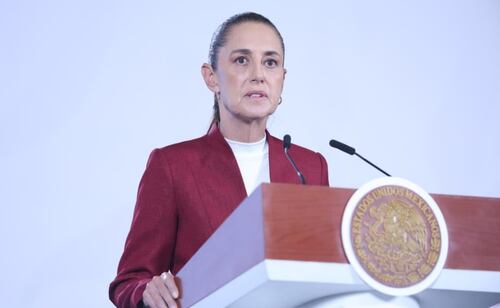
Mexico's Sheinbaum Rejects Trump Tariffs, Urges North American Integration via T-MEC
Translated from Spanish, summarized and contextualized by DistantNews.
At a glance
News
Sources not specified
Context piece
- Mexico's President Claudia Sheinbaum rejects former U.S. President Donald Trump's tariff policy, advocating for strengthening North America through the T-MEC trade agreement instead of imposing barriers.
- Sheinbaum stated that Mexico disagrees with tariffs in general and believes other mechanisms can foster economic competitiveness.
- She emphasized that strengthening North America as a solid economic bloc against other global regions is preferable to internal trade limitations, though the final trade policy decision rests with the U.S.
Mexican President Claudia Sheinbaum Pardo has reiterated her government's opposition to the tariff policies previously implemented by U.S. President Donald Trump. She advocates for reinforcing North American economic integration through the T-MEC trade agreement, rather than resorting to trade barriers between regional partners.
We have not agreed with tariffs, as you know, in practically any country.
When questioned about a lawsuit filed by 25 U.S. states against the federal government over tariffs, Sheinbaum declined to comment on internal U.S. matters. However, she affirmed Mexico's consistent disagreement with such measures, stating, "We have not agreed with tariffs, as you know, in practically any country."
We believe there are other mechanisms to strengthen one economic region against another, not just a scheme of thinking in particulars. In our case, it is better to think of North America with the trade treaty we have against other regions of the world, strengthening ourselves as a region rather than imposing internal limits.
Sheinbaum explained that alternative mechanisms exist to bolster economic competitiveness and navigate international trade challenges. Mexico's focus, she argued, should be on consolidating North America into a robust economic bloc to compete with other global regions, leveraging the integration provided by the T-MEC. "We believe there are other mechanisms to strengthen one economic region against another, not just a scheme of thinking in particulars. In our case, it is better to think of North America with the trade treaty we have against other regions of the world, strengthening ourselves as a region rather than imposing internal limits," she stated.
That has always been our opinion and we have expressed it, obviously, in negotiations. But it is a decision made by the United States government.
The president noted that Mexico has communicated this stance during bilateral negotiations with the United States. Nevertheless, she acknowledged that the formulation of trade policy is exclusively a U.S. prerogative. "That has always been our opinion and we have expressed it, obviously, in negotiations. But it is a decision made by the United States government," she said. She reiterated her refusal to comment on the lawsuit by U.S. state governments, calling it an internal U.S. affair.
What happens within the United States is their business.
DistantNews Editorial
Originally published by El Universal in Spanish. Translated, summarized, and contextualized by our editorial team with added local perspective. Read our editorial standards.
More Stories

From Our Blog

What Press Freedom Means for the News You Read

What Gets Lost (and Found) When News Is Translated

The Critical Role of Diaspora Media in Global News

What Travellers Should Know About Countries with Restricted Press

A Digital Nomad's Guide to Following Local News
