


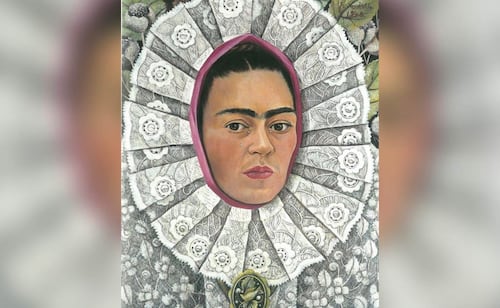
Mexico's Supreme Court to Rule on Frida Kahlo Painting Export
Translated from Spanish, summarized and contextualized by DistantNews.
At a glance
News
Named sources
Under investigation
- Mexico's Supreme Court will decide whether a Frida Kahlo painting can be permanently exported.
- The National Institute of Fine Arts and Literature (INBAL) denied the export of Kahlo's 1948 "Self-Portrait with Medallion," citing a 1984 presidential decree prohibiting exports of her declared artistic monuments.
- The painting's owner, a bank, argues that a federal law permits the export of privately owned artistic monuments, creating a conflict between the decree and the law.
Mexico's Supreme Court of Justice (SCJN) has taken on a case that could determine the fate of a Frida Kahlo painting, "Self-Portrait with Medallion," and potentially set a precedent for exporting artworks.
The painting, created by Kahlo in 1948, belongs to the banking institution Ve por más (Bx+). The bank filed a legal challenge in 2023 after the National Institute of Fine Arts and Literature (INBAL) denied its request for permanent export. INBAL's refusal was based on a 1984 presidential decree by Miguel de la Madrid, which declared Kahlo's works as artistic monuments and prohibited their export.
It seems very important to me that we can verify whether that provision contravenes what is stipulated in Article 16 of the Federal Law on Monuments... For these reasons that involve the positioning of this Supreme Court regarding cultural rights in terms of normative hierarchy, I will vote in favor of resuming jurisdiction.
However, the bank's legal team argues that this decree "exceeds" the scope of the Federal Law on Monuments and Archaeological, Artistic, and Historical Zones. Specifically, Article 16 of this law permits the definitive export of privately owned artistic monuments. The SCJN's decision to assume jurisdiction highlights the potential conflict between the specific decree and the broader federal law.
the core of the conflict consists in determining whether article sixth of the 1984 decree, by prohibiting the export of Frida Kahlo's work, introduces a restriction that is not provided for in article 16 of the Federal Law on Monuments, which does allow such export in the case of privately owned property and thus arrive at a constitutional definition.
During the court session, Justice Giovanni Figueroa Mejía emphasized the case's importance in balancing "the right to culture against the right to property." He stated the need to verify if the 1984 decree's export prohibition contradicts Article 16 of the Federal Law on Monuments, particularly concerning the hierarchy of norms. Justice Arístides Guerrero García further clarified that the core issue is to determine if the 1984 decree's restriction on exporting Kahlo's work imposes a limitation not found in Article 16, which allows such exports for private property.
The "Self-Portrait with Medallion" depicts Kahlo with tears on her face, wearing a Tehuana dress. The Frida Kahlo Museum noted in 2023 how the artist used fashion as a "statement of empowerment," blending her Mexican identity and disabilities into a distinctive visual style that asserted her presence in the art world during a time when female artists struggled for recognition.
statement of empowerment
DistantNews Editorial
Originally published by El Universal in Spanish. Translated, summarized, and contextualized by our editorial team with added local perspective. Read our editorial standards.
More Stories


From Our Blog

What Press Freedom Means for the News You Read

What Gets Lost (and Found) When News Is Translated

The Critical Role of Diaspora Media in Global News

What Travellers Should Know About Countries with Restricted Press

A Digital Nomad's Guide to Following Local News
