

Michoacán promotes forest ecosystem restoration; disperses 200,000 seeds with drones in seven municipalities
Translated from Spanish, summarized and contextualized by DistantNews.
At a glance
News
Named sources
New plan
- Michoacán is using drones to disperse 200,000 forest seeds across seven municipalities to restore ecosystems.
- The "Bio Renace: Dispersing Life" program aims to recover forest areas, especially those affected by fires.
- The initiative prioritizes intervention in 18 Protected Natural Areas and key river basins, with work concluding by July 15.
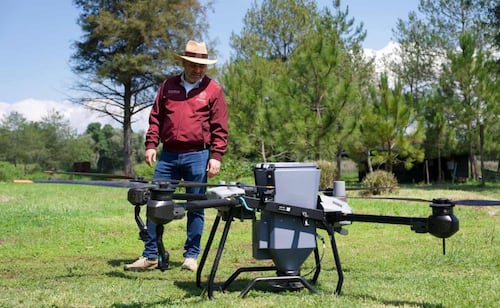
Michoacán is launching an innovative reforestation effort, dispersing 200,000 forest seeds using drones across seven municipalities. Governor Alfredo Ramírez Bedolla announced the "Bio Renace: Dispersing Life" program, which aims to restore the state's forest ecosystems.
"We are betting on the use of technology for the care of our forests, with key strategies such as the use of drones that allow us to reach difficult-to-access areas and recover our forest lands," explained the state leader. The program began in Pátzcuaro, specifically in the Estribo Grande area, where the first 12,000 pine seeds were dispersed in a zone impacted by forest fires.
The initiative, led by the Michoacán Forestry Commission, will cover areas in the municipalities of Los Reyes, Nuevo Urecho, Pátzcuaro, Quiroga, Tacámbaro, Tzitzio, and Uruapan. Drone technology will be used to spread "germospheres" – seeds coated with a substrate – to enhance their protection and establishment.
During the current rainy season, seeds from five forest species will be distributed: Pinus pseudostrobus, Pinus devoniana, Swietenia humilis, Enterolobium cyclocarpum, and Leucaena leucocephala. The project is scheduled to conclude by July 15. Priority interventions will focus on 18 Protected Natural Areas and crucial river basins, including Pátzcuaro, Río Duero, Cuitzeo, and Cutzamala.
We are betting on the use of technology for the care of our forests, with key strategies such as the use of drones that allow us to reach difficult-to-access areas and recover our forest lands.
DistantNews Editorial
Originally published by El Universal in Spanish. Translated, summarized, and contextualized by our editorial team with added local perspective. Read our editorial standards.
More Stories
From Our Blog

What Press Freedom Means for the News You Read

What Gets Lost (and Found) When News Is Translated

The Critical Role of Diaspora Media in Global News

What Travellers Should Know About Countries with Restricted Press

A Digital Nomad's Guide to Following Local News
