


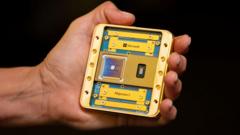
Microsoft says new quantum chip 1,000 times more reliable than predecessor
Summarized and contextualized by DistantNews.
At a glance
News
Sources not specified
New plan
- Microsoft has unveiled its new Majorana 2 quantum chip, claiming it is 1,000 times more reliable than its predecessor.
- The improved chip's qubits can maintain their state for 20 seconds, a significant increase from milliseconds, potentially enabling quantum computers to solve commercially relevant problems by 2029.
- While Microsoft cites commercial confidentiality for full details, experts suggest the advancement is plausible, though the company has faced past skepticism and retracted research claims.
Microsoft announced a significant advancement in quantum computing with its new Majorana 2 chip, which the company claims is 1,000 times more reliable than its previous version. This leap in stability means the chip's qubits can maintain their quantum state for an average of 20 seconds, a vast improvement from the milliseconds achieved by Majorana 1.
We will have a quantum machine in 2029 that can solve commercially viable, reasonable problems.
This enhanced reliability is a crucial step toward building a quantum computer capable of solving commercially viable problems. Zulfi Alam, corporate vice president of Microsoft Quantum, stated, "We will have a quantum machine in 2029 that can solve commercially viable, reasonable problems." However, he noted that such a device would still require millions of qubits, while the current chip has only 12.
Microsoft appears to have made a leap in their attempt to produce viable topological qubits.
Microsoft's pursuit of quantum computing, particularly its "topological" approach, has been ongoing for 20 years. This method relies on exploiting the properties of quasi-particles predicted in the 1930s. The company faced skepticism and even retracted a paper in 2018 claiming evidence for Majorana particles. Despite these challenges, Microsoft continued its research, releasing its first Majorana chip in 2025.
If they succeed, they will leap from being a player with no production quantum computer, to being a serious player in the race to make the next generation of fault-tolerant machines.
Experts acknowledge the potential of Microsoft's claims. Paul Stevenson, a physics professor at the University of Surrey, called the timeline plausible if the research holds up, stating, "If they succeed, they will leap from being a player with no production quantum computer, to being a serious player in the race to make the next generation of fault-tolerant machines." However, assessing the firm's exact progress is difficult due to commercial confidentiality, and past criticisms from physicists like Henry Legg have questioned whether the research had "moved firmly away from science and entered the realm of faith."
in my opinion Microsoft's quantum research had moved firmly away from science and entered the realm of faith
DistantNews Editorial
Originally published by BBC News. Summarized and contextualized by our editorial team with added local perspective. Read our editorial standards.
More Stories



From Our Blog

What Gets Lost (and Found) When News Is Translated

The Critical Role of Diaspora Media in Global News

What Travellers Should Know About Countries with Restricted Press

A Digital Nomad's Guide to Following Local News

How the Same Story Looks Different in Different Countries
