


Milan hospital tests robot to free up healthcare staff time
Translated from Spanish, summarized and contextualized by DistantNews.
At a glance
News
Sources not specified
Context piece
- A robot named 'Alter-Ego' is being tested at a Milan hospital to assist healthcare staff with basic patient care tasks.
- The robot can interact with patients, deliver water, and transmit patient data to nurses, aiming to reduce staff workload.
- Developed by the Italian Institute of Technology and the University of Pisa, the robot is expected to become autonomous by July and could eventually assist patients at home.
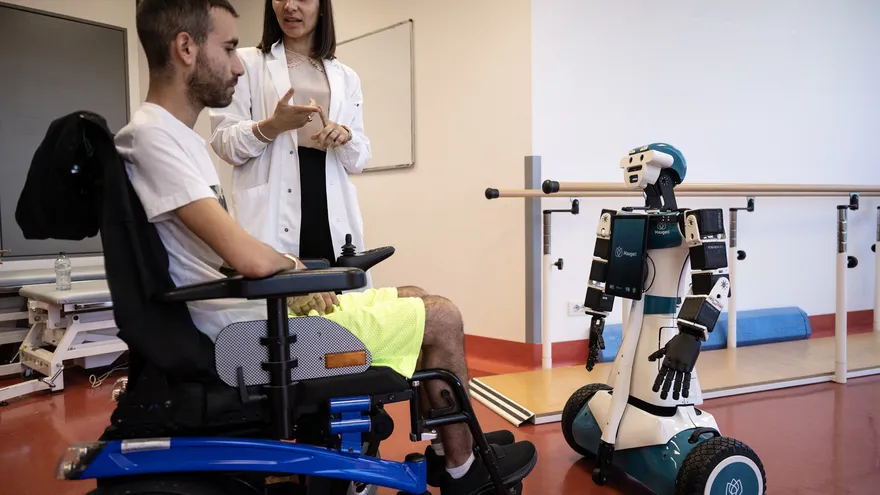
A hospital in Milan is piloting a novel robot designed to ease the burden on healthcare professionals by taking on essential but basic patient-related tasks. The robot, dubbed 'Alter-Ego,' stands 1.2 meters tall and features expressive eyebrows, allowing it to interact with patients in a way that aims to foster curiosity rather than apprehension.
Hello, Dani. How are you? Do you need anything?
At the Maugeri hospital, 'Alter-Ego' has been undergoing trials since April in a department specializing in amyotrophic lateral sclerosis (ALS) treatment. Patients like 31-year-old Daniel Senna, who uses a wheelchair, can communicate their pain levels via a screen on the robot's chest. The robot then relays this information to nursing staff, ensuring timely attention.
Christian Lunetta, director of neuromotor rehabilitation at the hospital, initially harbored concerns about patient reactions but expressed satisfaction with the robot's reception. He noted that 'Alter-Ego' was specifically designed to be engaging and versatile, with functions that suggest a wide range of potential applications.
At first, we were afraid that the patient might react negatively.
This project, a collaboration between the Italian Institute of Technology and the University of Pisa, is a step towards greater automation in healthcare. While currently operated remotely, 'Alter-Ego' is slated to become autonomous by July. The rapid advancements in artificial intelligence are fueling progress in robotics, though extensive training remains crucial for unsupervised operation. Manuel Catalano of the Italian Institute of Technology emphasized that the experiment aims to understand the boundaries of robotic assistance in hospitals through collaboration with patients and caregivers.
But we were soon very satisfied, because the robot was designed to awaken curiosity and its movements -- or at least its functions -- point to a wide range of possible uses.
Looking ahead, 'Alter-Ego' could extend its assistance to patients in their homes. Lunetta highlighted that hospitals often have repetitive tasks that could be delegated to robots, thereby allowing human staff to focus more on patient relationships and complex care. While 'Alter-Ego' is not equipped for tasks like administering medication, its ability to handle requests directly from patients could reduce caregiver workload and enhance patient comfort.
This also would allow us to value human work more, giving more time to focus on the relationship with patients.
DistantNews Editorial
Originally published by TVN Panamá in Spanish. Translated, summarized, and contextualized by our editorial team with added local perspective. Read our editorial standards.
More Stories


From Our Blog

What Gets Lost (and Found) When News Is Translated

The Critical Role of Diaspora Media in Global News

What Travellers Should Know About Countries with Restricted Press

A Digital Nomad's Guide to Following Local News

How the Same Story Looks Different in Different Countries
