


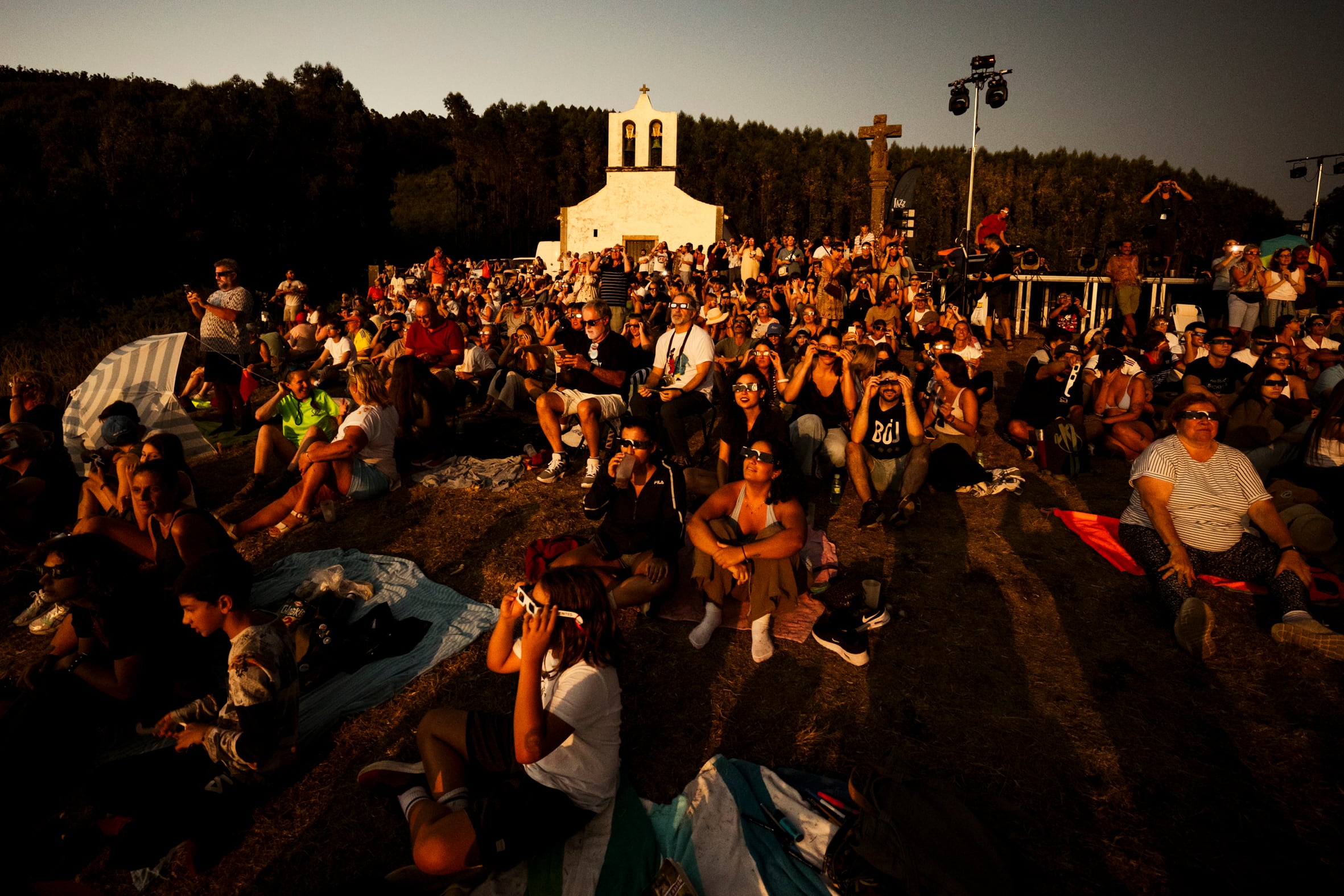
Millions of Spaniards marvel at the solar eclipse: 'I want another one! When is there another one?'
Translated from Spanish, summarized and contextualized by DistantNews.
At a glance
News
Sources not specified
Context piece
- Millions of Spaniards watched the first solar eclipse of the century, experiencing moments of emotion and celebration across the country.
- The eclipse traced a path from Galicia to the Valencian Community, creating a temporary twilight and a noticeable drop in temperature.
- Despite cloudy conditions in some areas, like Galicia, many gathered in diverse locations to witness the celestial event.
Millions of Spaniards marveled at the country's first solar eclipse of the century, erupting in cheers, applause, and even tears of emotion. The celestial event, which occurred around 8:30 PM, cast a shadow across a vast swathe of the Iberian Peninsula, from Galicia to the Valencian Community, before disappearing into the sea near the Balearic Islands. As a false twilight descended and the August heat subsided, the long-awaited moment arrived: the Moon completely obscured the Sun, prompting widespread celebration among the thousands of Spaniards and tourists gathered on beaches, in fields, at official viewpoints, and even atop medieval castles.
I want another one! When is there another one?
EL PAÍS documented the experience across various locations experiencing totality. The eclipse coincided with August, a month when many Spaniards slow down, return to their hometowns, and dedicate more time to rest and family. The phenomenon entered the peninsula at Punta Herbosa in Mañón, A Coruña, around 7:30 PM, with the Moon beginning to obscure the Sun. Less than an hour later, the satellite fully covered the sun at Estaca de Bares, plunging the peninsula into darkness within seconds.
However, the viewing experience in Galicia was subject to the region's notoriously unpredictable weather. In Caión, A Laracha, clouds threatened throughout the morning and returned in the afternoon, jeopardizing the unique views. Residents and an estimated 6,000 visitors had gathered, with local authorities implementing a mobility plan. "You can't see anything," lamented some locals and visitors, including Juan Carlos Montes López, who traveled with his family, hoping his son would see the eclipse through a telescope. Despite the frustration, occasional glimpses of the partially obscured sun were visible through breaks in the clouds, accompanied by a sudden drop in temperature, hinting at the astronomical spectacle unfolding above.
You can't see anything.
In other parts of the country, the eclipse was more clearly visible. The event provided a shared experience, uniting people in awe of a natural wonder. The temporary darkness and temperature drop served as tangible evidence of the cosmic alignment, even for those who could only catch fleeting views through the clouds. The collective anticipation and shared experience, regardless of perfect viewing conditions, underscored the significance of the event for many.
It's a bit frustrating.
DistantNews Editorial
Originally published by El País in Spanish. Translated, summarized, and contextualized by our editorial team with added local perspective. Read our editorial standards.
More Stories


From Our Blog

What Gets Lost (and Found) When News Is Translated

The Critical Role of Diaspora Media in Global News

What Travellers Should Know About Countries with Restricted Press

A Digital Nomad's Guide to Following Local News

How the Same Story Looks Different in Different Countries
