


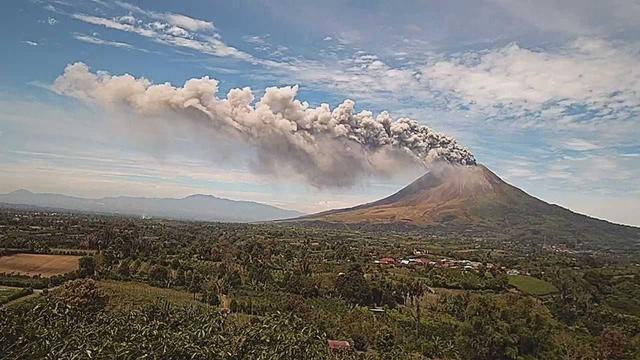
Mount Sinabung erupts on Sumatra, sending ash 3,500 meters into the air
Translated from German and summarized by DistantNews. Read the original for the full story.
At a glance
Newswire
From a news agency
Ongoing story
- Mount Sinabung on Indonesia’s Sumatra island produced an ash column about 3,500 meters high during an eruption lasting at least an hour.
- Authorities have placed the volcano at the second level of a four-tier warning system and set exclusion zones extending up to 4.5 kilometers.
- Sinabung returned to activity in 2010 after centuries of relative quiet, and a 2014 eruption killed at least 16 people.
Mount Sinabung erupted on Indonesia’s Sumatra island and sent an ash column roughly 3,500 meters into the sky. The eruption lasted at least an hour, according to Indonesia’s volcanology agency, PVMBG.
No deaths or injuries had initially been reported. Authorities urged villagers, visitors and tourists to stay away from the volcano. The exclusion zone covers three kilometers around the summit and extends up to 4.5 kilometers along the southeastern flank.
The 2,460-meter volcano stands in the Karo Highlands, about 50 kilometers southwest of Medan. It ranks among Indonesia’s most active volcanoes. After centuries of relative dormancy, Sinabung became active again in 2010. An eruption in 2014 killed at least 16 people, while later eruptions and ash clouds repeatedly forced residents to leave their homes.
Indonesia sits on the Pacific Ring of Fire and has about 130 active volcanoes, more than any other country.
About this summary
Originally published by Die Zeit in German. Translated, summarized, and contextualized automatically by DistantNews, with a note on how the source frames the story. Not individually reviewed before publishing. How this works.
More Stories



From Our Blog

What Gets Lost (and Found) When News Is Translated

How the Same Story Looks Different in Different Countries

The Critical Role of Diaspora Media in Global News

What Travellers Should Know About Countries with Restricted Press

A Digital Nomad's Guide to Following Local News
