


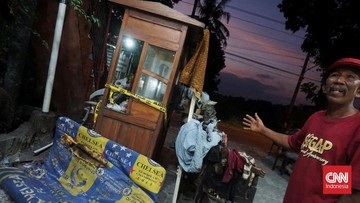
Mysterious Fires Spread Outside Indonesian Home, Methane Gas Suspected
Translated from Indonesian, summarized and contextualized by DistantNews.
At a glance
News
Named sources
Ongoing story
- Mysterious fires continue to spread at a residence in Sleman, Indonesia, now affecting areas outside the main building.
- The fires have occurred 81 times over the past eleven days, with new ignition points appearing both inside and outside the house.
- Researchers are investigating potential causes, with methane gas being a leading theory.
Mysterious fires are continuing to break out at the home of Mutfiana, known as Fia, in Seyegan, Sleman, Indonesia, with the phenomenon now spreading to areas outside the main building. Agus, Fia's father, reported that fire outbreaks on Monday and Tuesday evenings ignited materials on the north side and behind their house, which the family has been using as a temporary shelter for the past eleven days.
It has spread outside, it happened twice yesterday.
These recent outbreaks, though extinguished before becoming major, mark an escalation. Agus noted that the fires have occurred randomly and in different locations, with some spots igniting multiple times. He has counted 81 separate fire incidents since the phenomenon began eleven days ago, with the number of ignition points exceeding 65.
If it had ignited cloth, the fire would have been large.
Even areas within the house that previously showed no signs of fire are now being affected. The unpredictable nature of the fires, occurring at random times and locations, has kept the family on edge. Local authorities have provided fire extinguishers and emergency response teams, volunteers, and residents are actively maintaining a vigil.
The timing is random, the places are different. Some spots have ignited three times, some a few times, like that.
Researchers from Gadjah Mada University and UPN "Veteran" Yogyakarta are investigating the cause. While UGM researchers initially suspected hydrogen gas, the UPN team points to methane gas. Basuki Rahmat, Dean of the Faculty of Mineral and Energy Technology at UPN, believes the recent fires outside the house strengthen the methane theory, suggesting it is emanating from beneath the ground. A geophysics team is scheduled to map the underground rock layers suspected of carrying methane.
This further strengthens the belief that methane gas is present beneath the surface and is escaping into the air. The CH4 molecule does tend to adhere to H2O molecules, like moisture. Methane gas likes damp areas.
DistantNews Editorial
Originally published by CNN Indonesia in Indonesian. Translated, summarized, and contextualized by our editorial team with added local perspective. Read our editorial standards.
More Stories


From Our Blog

What Gets Lost (and Found) When News Is Translated

The Critical Role of Diaspora Media in Global News

What Travellers Should Know About Countries with Restricted Press

A Digital Nomad's Guide to Following Local News

How the Same Story Looks Different in Different Countries
