


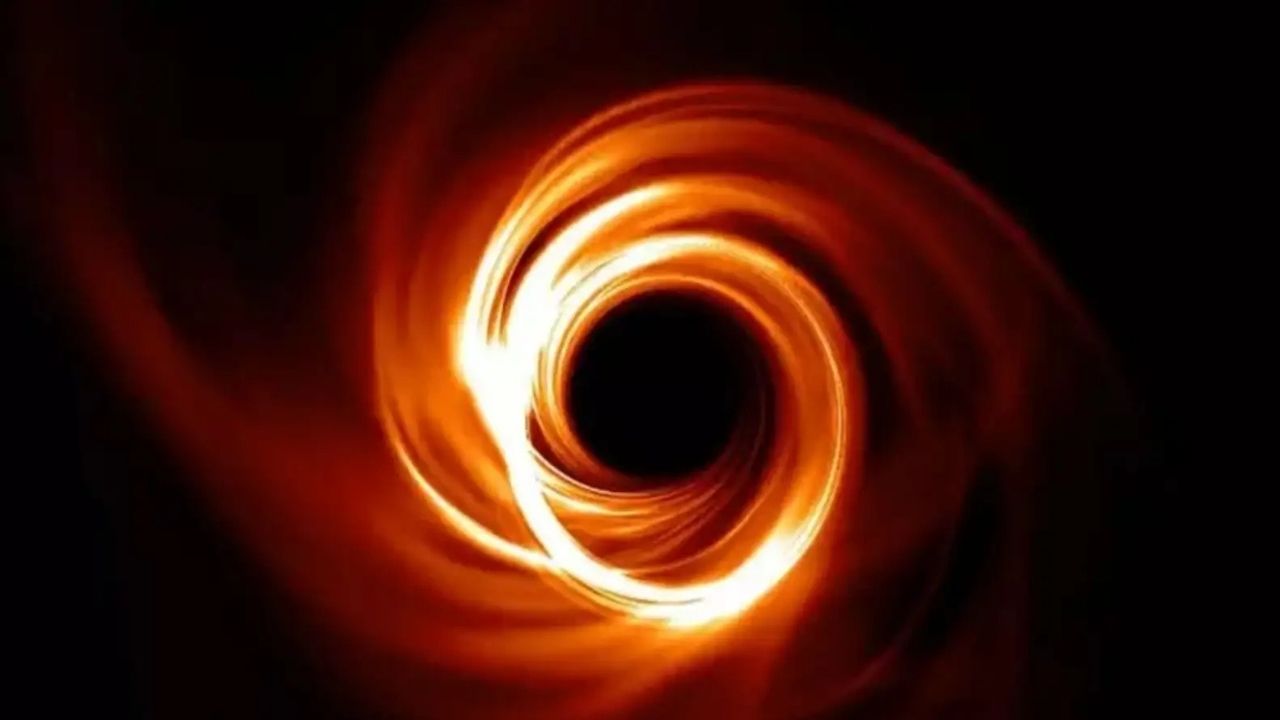
Mystery of Milky Way's central black hole solved: Cosmic wind found
Translated from Turkish, summarized and contextualized by DistantNews.
At a glance
News
Named sources
Outcome reported
- Scientists have discovered evidence of a cosmic wind emanating from Sagittarius A*, the supermassive black hole at the center of the Milky Way.
- This discovery resolves a 50-year mystery, as Sgr A* had not exhibited the expected material ejections seen in other black holes.
- Using the ALMA telescope, researchers identified a cone-shaped void near the black hole, suggesting a hot gas wind is sweeping away surrounding cold matter.
A groundbreaking discovery has potentially solved a 50-year-old enigma in astrophysics concerning Sagittarius A*, the supermassive black hole at the Milky Way's center. For decades, scientists have been puzzled by Sgr A*, which is four million times the mass of our Sun, because it did not exhibit the powerful jets or winds typically ejected by such massive celestial objects.
New longitudinal analyses conducted by U.S. scientists and published in The Astrophysical Journal Letters have provided concrete data that deciphers the mechanism behind this unexpected silence. The research utilized the Atacama Large Millimeter/Submillimeter Array (ALMA) in Chile, the world's most sensitive radio telescope system, to create the highest-resolution microwave map of the galactic center to date.
After filtering out radio interference from the data, the research team identified a colossal, cone-shaped void extending approximately three light-years from the black hole. This region, devoid of cold gas, is situated at a 45-degree angle. The scientists concluded that this structure could only be formed by a hot gas wind originating from the black hole's core, acting like a cosmic hairdryer that sweeps away surrounding cold matter.
The half-century quest to understand Sgr A*'s quiet nature was hampered by two major challenges. Firstly, telescope technology capable of penetrating the vast clouds of cosmic dust and gas between Earth and the galactic center has only recently become available. Secondly, Sagittarius A* is currently in a "quiet period," meaning it has insufficient surrounding matter to generate the powerful outflows observed in black holes of distant galaxies, which often create spectacular, fireworks-like explosions stretching billions of light-years.
This electrically charged hot plasma flow, confirmed by data from NASA's Chandra X-ray Observatory, explains the weak, breeze-like wind produced by our galaxy's central black hole. The discovery sheds new light on the behavior of black holes and the dynamics of galactic centers.
DistantNews Editorial
Originally published by Cumhuriyet in Turkish. Translated, summarized, and contextualized by our editorial team with added local perspective. Read our editorial standards.
More Stories



From Our Blog

What Gets Lost (and Found) When News Is Translated

The Critical Role of Diaspora Media in Global News

What Travellers Should Know About Countries with Restricted Press

A Digital Nomad's Guide to Following Local News

How the Same Story Looks Different in Different Countries
