


NASA's ambitious Artemis III plan: 3 rockets, 2 orbital dockings, and an unprecedented operation
Translated from Spanish, summarized and contextualized by DistantNews.
At a glance
News
Sources not specified
New plan
- NASA's Artemis III mission, planned for 2027, is designed as one of the most complex space operations in decades.
- The mission requires coordinating three powerful rockets and involves two in-orbit spacecraft dockings.
- Four astronauts will participate, testing new technologies and procedures for future lunar expeditions.
NASA has unveiled the intricate plan for its Artemis III mission, slated for 2027, which promises to be one of the most complex space operations in recent history. This expedition will rigorously test new technologies and procedures through an unprecedented sequence of launches and orbital maneuvers.
Unlike previous crewed missions, Artemis III necessitates the coordination of three of the world's most powerful rockets. The mission will carry four astronauts and feature two mid-flight spacecraft dockings, serving as a critical trial run for future Artemis program expeditions.
The operation begins with the launch of Blue Origin's exploration lander. This vehicle will be sent into space ahead of the crew and will remain in Earth orbit for several weeks, awaiting the astronauts' arrival.
Subsequently, NASA will launch its Space Launch System (SLS) rocket, carrying the four mission crew members aboard the Orion spacecraft. Once in Earth orbit, Orion will rendezvous with the Blue Origin vehicle for the first of two planned dockings. The two spacecraft will remain connected for approximately two days while the astronauts conduct technical checks, operational tests, and procedure demonstrations, including familiarization with the lander.
Following the tests with Blue Origin, Orion will undock and continue in orbit, awaiting a second rendezvous. This is when SpaceX's Starship, the lunar exploration vehicle, enters the picture. After its launch, Starship will meet Orion to complete another docking in space. For about a day, both spacecraft will undergo checks and trials to validate systems and operations essential for later stages of the Artemis program.
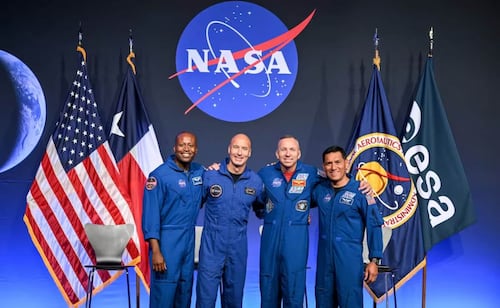
Upon completion of all tests, the astronauts will re-board the Orion spacecraft exclusively for their return journey to Earth. The capsule will splash down in the Pacific Ocean, where it will be recovered by U.S. Navy and NASA teams, mirroring procedures from current U.S. space program missions. The primary crew includes mission commander Randy Bresnik, European Space Agency (ESA) astronaut Luca Parmitano as pilot, and crew members Andre Douglas and Frank Rubio.
DistantNews Editorial
Originally published by El Universal in Spanish. Translated, summarized, and contextualized by our editorial team with added local perspective. Read our editorial standards.
More Stories



From Our Blog

What Press Freedom Means for the News You Read

What Gets Lost (and Found) When News Is Translated

The Critical Role of Diaspora Media in Global News

What Travellers Should Know About Countries with Restricted Press

A Digital Nomad's Guide to Following Local News
