


NASA's Roman Space Telescope: A spy camera's second act
Translated from English and summarized by DistantNews. Read the original for the full story.
At a glance
News
From a news agency
New plan
- NASA is preparing to launch the Nancy Grace Roman Space Telescope, originally developed by the National Reconnaissance Office.
- The telescope will survey a billion galaxies to study dark matter, dark energy, and the expansion of the universe.
- Roman will also search for rogue planets and test technology for detecting Earth-like exoplanets.
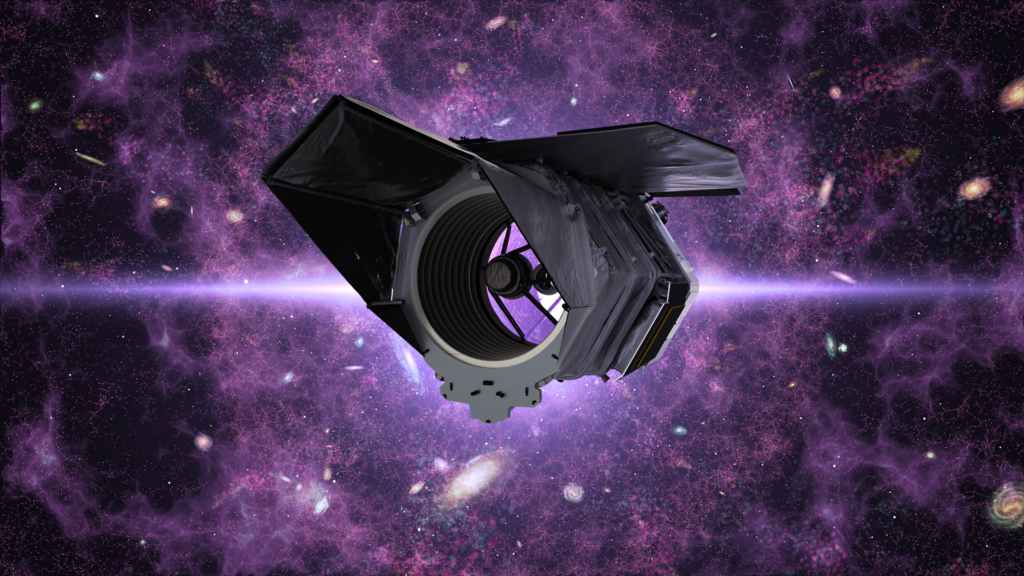
NASA is gearing up to launch the Nancy Grace Roman Space Telescope, a powerful new instrument with roots in America's intelligence community. Originally developed by the National Reconnaissance Office (NRO), the telescope was transferred to NASA in 2012 when the spy agency no longer needed the hardware. After more than a decade of modifications, NASA aims to send Roman into space as early as August 30, 2026.
Once operational, Roman is expected to revolutionize our understanding of the cosmos. Its primary mission is to survey a billion galaxies, providing data that astronomers hope will answer some of the universe's most profound questions. A key focus will be the study of dark matter and dark energy, the mysterious components that make up the vast majority of the universe's energy but whose physical nature remains unknown. The telescope will also observe exploding stars, known as supernovas, to precisely measure the rate at which the universe is expanding.
Beyond its cosmological goals, Roman will also turn its gaze closer to home. It will monitor subtle variations in starlight to detect rogue planets drifting through the Milky Way galaxy. Additionally, Roman is equipped with a coronagraph instrument designed to test technology for future missions aimed at directly detecting Earth-like planets orbiting other stars. This coronagraph works by blocking out the intense light of a star, allowing the much fainter light of orbiting planets to be observed.
Roman's design, inherited from its NRO origins, offers a significant advantage: a wide field of view. Unlike telescopes like Hubble, which capture detailed images of narrow sky sections, Roman can observe much larger swathes of the sky simultaneously. This capability will enable astronomers to map the three-dimensional distribution of dark matter and study phenomena across vast cosmic distances more efficiently.
About this summary
Originally published by PBS NewsHour in English. Translated, summarized, and contextualized automatically by DistantNews, with a note on how the source frames the story. Not individually reviewed before publishing. How this works.
More Stories



From Our Blog

How the Same Story Looks Different in Different Countries

What Gets Lost (and Found) When News Is Translated

The Critical Role of Diaspora Media in Global News

What Travellers Should Know About Countries with Restricted Press

A Digital Nomad's Guide to Following Local News
