


National Pension Fund Exhaustion Delayed to 2069 as Market Boom Boosts Returns
Translated from Korean, summarized and contextualized by DistantNews.
At a glance
News
Sources not specified
Context piece
- South Korea's National Pension Service (NPS) fund exhaustion date has been pushed back to 2069, four years later than previously projected.
- Strong investment returns, particularly in domestic stocks in 2025, significantly boosted the fund's assets.
- The analysis highlights the crucial role of investment performance in ensuring the long-term financial stability of the pension system.
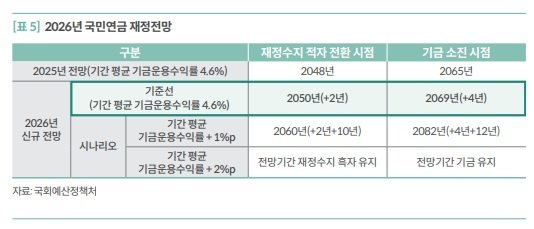
South Korea's National Pension Service (NPS) fund is now projected to be exhausted in 2069, a four-year delay from earlier forecasts, thanks to a recent surge in investment returns. A report from the National Assembly Budget Office (NABO) indicates that the fund's financial balance is expected to turn negative in 2050, but robust asset management performance has significantly extended its solvency.
This improved outlook is largely attributed to high investment yields between 2023 and 2025. The NPS fund's assets have grown substantially, reaching an estimated 1526.1 trillion won as of March. While the fund experienced a negative return of -8.22% in 2022, it saw significant recovery with returns of 13.59% in 2023, 15.00% in 2024, and a projected 18.82% in 2025.
The analysis results confirm that the financial status of the National Pension can vary greatly depending on the fund management performance. These results suggest that improving fund management performance is a crucial policy task directly linked to securing the financial stability of the National Pension.
Notably, domestic stock investments showed exceptional performance, soaring to 82.44% in 2025, far outperforming overseas stocks (19.74%), bonds (1.48%), and alternative investments (8.03%) during the same period. This strong performance in the stock market has been the primary driver in delaying the fund's depletion.
The NABO analysis further suggests that a sustained increase in average investment returns could further postpone the exhaustion date. A 1%p rise in average returns could push the deficit turning point to 2060 and fund exhaustion to 2082. If returns increase by 2%p, the fund could remain in surplus indefinitely. This underscores the critical link between investment performance and the long-term financial health of the national pension system, emphasizing the importance of maximizing fund returns to ensure future benefit payments and policy flexibility.
Accumulating additional assets through sound management performance during the current period of financial surplus can strengthen the positive impact on the finances in the long term due to the compounding effect of asset management. Improving fund management performance can enhance confidence in the National Pension's ability to pay benefits and broaden the scope of policy choices for future benefit enhancements or system improvements.
DistantNews Editorial
Originally published by Dong-A Ilbo in Korean. Translated, summarized, and contextualized by our editorial team with added local perspective. Read our editorial standards.
More Stories


From Our Blog

What Gets Lost (and Found) When News Is Translated

The Critical Role of Diaspora Media in Global News

What Travellers Should Know About Countries with Restricted Press

A Digital Nomad's Guide to Following Local News

How the Same Story Looks Different in Different Countries
