


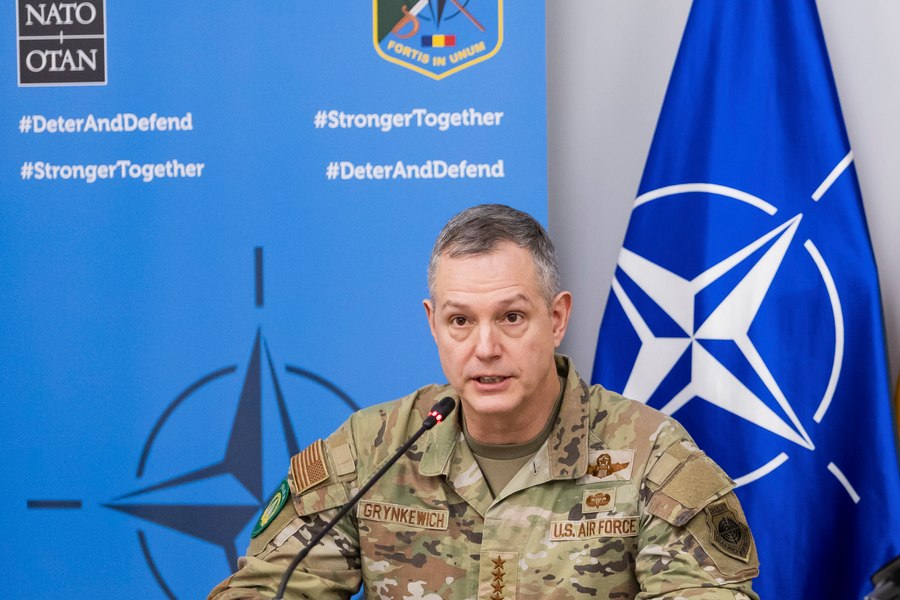
NATO Considers Expanding Commander's Powers Amid Increased Drone Incursions
Translated from Romanian, summarized and contextualized by DistantNews.
At a glance
News
Named sources
Ongoing story
- NATO is considering granting its supreme military commander in Europe, General Alexus Grynkewich, more autonomy to respond to increased drone incursions.
- The proposed changes would allow Grynkewich to more flexibly set alert levels and reallocate air defense assets without needing formal approval from each member state.
- This initiative stems from a rise in drone incidents across NATO's eastern flank, including in Poland, Romania, Estonia, and Latvia, prompting a strategic review of military response capabilities.
NATO member states are contemplating granting greater operational freedom to the Alliance's supreme military commander in Europe, U.S. General Alexus Grynkewich, in response to a surge in drone incidents. Diplomatic sources indicate a proposal, potentially to be approved at the NATO summit in Ankara on July 7-8, aims to enable faster reactions to aerial threats.
The proposed plan would empower General Grynkewich to set alert levels and redistribute air defense resources within the Alliance more flexibly. Currently, the use of military equipment is strictly governed by national regulations, which NATO officials argue hinders rapid response capabilities crucial for addressing modern threats. This initiative arises amid escalating incidents, including drone incursions into Poland and Romania, airspace violations in Estonia, and the appearance of suspicious aircraft in Latvia, some resulting in damage and casualties.
The plan provides that Alexus Grynkewich will be able to set alert levels more flexibly and redistribute air defense assets within the Alliance, without having to seek formal approvals from each member state.
The plan also includes integrating missile defense systems into NATO's air policing missions, particularly along the Alliance's eastern flank. Several member states have previously criticized national restrictions, viewing them as obstacles to effective coordination against aerial threats. Discussions regarding the relaxation of these limitations have intensified in recent months, particularly after Iranian ballistic missile launches toward Turkey, which underscored the need for a unified Alliance approach.
Recent reports, such as one published by the Swedish Parliament's Defence Committee, suggest Russia may conduct actions to test NATO's resilience in the near future if the political climate is deemed favorable. This strategic context further emphasizes the urgency behind NATO's potential shift towards a more agile and centralized command structure for air defense.
Several member states have previously criticized national restrictions, considered an obstacle to the effective coordination of the response to aerial threats.
DistantNews Editorial
Originally published by Adevărul in Romanian. Translated, summarized, and contextualized by our editorial team with added local perspective. Read our editorial standards.
More Stories

From Our Blog

What Gets Lost (and Found) When News Is Translated

The Critical Role of Diaspora Media in Global News

What Travellers Should Know About Countries with Restricted Press

A Digital Nomad's Guide to Following Local News

How the Same Story Looks Different in Different Countries
