


Nepal Issued a Disaster Alert 38 Minutes After the Glacier Collapse, but It Was Too Late
Translated from English and summarized by DistantNews. Read the original for the full story.
At a glance
Analysis
Named sources
Context piece
- A glacier collapse near the Nepal-Tibet border triggered a flash flood that struck communities with little warning.
- Experts say Nepal’s hazard systems remain fragmented, with sensors and alerts focused on individual threats rather than cascading disasters.
- Officials recorded seismic activity but did not issue a public alert because it did not match the department’s earthquake-monitoring mandate.
Nima Dorje Tamang heard a thunderous roar before he saw the flood racing toward Hakubesi, its waves taller than him. He and his family ran uphill, but the water caught him and a rock fractured his leg. Swept into the river, he clung to a tree near the bank until his father and brother rescued him.
Even the air makes it hurt.
Tamang spent the next 24 hours slipping in and out of consciousness before a helicopter took him to Kathmandu. At Tribhuvan University Teaching Hospital, doctors found his foot still swollen after surgery. “Even the air makes it hurt,” he told them as they pressed it. From his hospital bed, he also worried about relatives at home. “We lost our uncle, aunt, sister, and brother-in-law,” he said. “And everyone says there will be a massive flood again.”
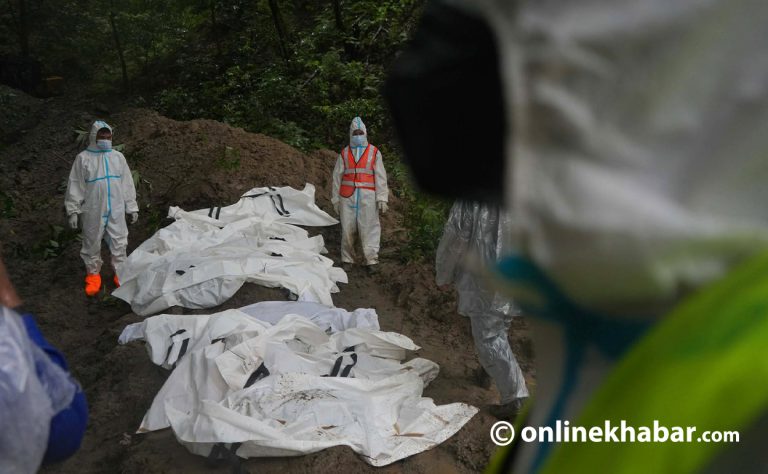
The glacier collapse struck the Lhende valley near the Nepal-Tibet border at 8:37 a.m. on August 26. Scientists said predicting this particular type of disaster would have been difficult, and the flash flood moved so quickly through the steep terrain that downstream communities had little time to react.
We lost our uncle, aunt, sister, and brother-in-law.
But the disaster also exposed weaknesses in Nepal’s warning arrangements. Anil Pokhrel, the former chief executive of the National Disaster Risk Reduction and Management Authority, said sensors alone do not amount to an early warning system. He argued that Nepal needs risk assessments, real-time observation, communications that deliver alerts promptly, and emergency preparedness.
And everyone says there will be a massive flood again.
The Department of Mines and Geology recorded seismic activity during the collapse, registering a magnitude of 4.4. Lok Vijay Adhikari, chief of the National Earthquake Monitoring and Research Center, said the activity did not resemble an earthquake, so the department did not alert the public in its usual way. Pokhrel said a stronger system would connect upstream sensors to sirens, text messages and other automatic warnings, while monitoring several hazards across different locations.
There is no such thing as an early warning system in Nepal. Simply having sensors does not mean it’s a system; it has to be much more comprehensive.
About this summary
Originally published by Kathmandu Post in English. Translated, summarized, and contextualized automatically by DistantNews, with a note on how the source frames the story. Not individually reviewed before publishing. How this works.
More Stories

From Our Blog

What Gets Lost (and Found) When News Is Translated

The Critical Role of Diaspora Media in Global News

What Travellers Should Know About Countries with Restricted Press

A Digital Nomad's Guide to Following Local News

How the Same Story Looks Different in Different Countries
