


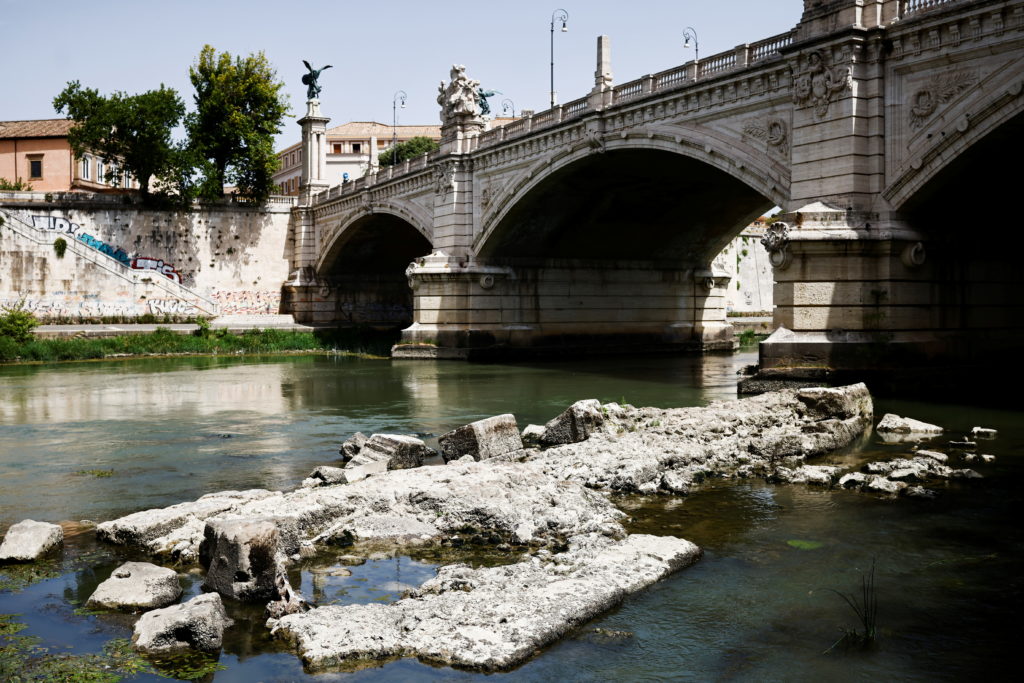
Nero's Bridge emerges from Tiber River as Rome grapples with water crisis
Translated from English, summarized and contextualized by DistantNews.
At a glance
News
Named sources
Context piece
- The remains of an ancient bridge, known as Nero's Bridge, have emerged in Rome's Tiber River due to significantly low water levels caused by a prolonged drought.
- The bridge, believed to be older than Emperor Nero's era and possibly built by Caligula, once connected Rome's city center to the Tiber's right bank.
- Rome is facing a severe water crisis, with Tiber River flow rates at about half the historic average for July, exacerbating the impact of dry periods following a wet winter.
Weeks of minimal rainfall have caused Rome's Tiber River to recede, revealing the ancient remains of Nero's Bridge near St. Peter's Basilica. The dramatic drop in water levels, with the river's flow falling below 80 cubic meters per second, half the historic July average, highlights the severity of the ongoing water crisis in the Italian capital.
Archaeologists identify the structure as Nero's Bridge, named after the Roman emperor, though scholars suggest it predates his reign, potentially built by his uncle Caligula as early as 39 AD. The bridge historically served to connect the city center with the Tiber's right bank. The discovery offers a stark visual reminder of the environmental challenges Rome faces, particularly the impact of prolonged dry spells on its vital waterways.
Nero is the most famous person linked to this area, because precisely in Nero's circus, where the Vatican is now located, the Apostle Peter was martyred. However, scholars consider the bridge to be older (than Nero's era), built by Caligula, Nero's uncle.
Giovanni Giganti, coordinator of the Rome civil protection service's water management center, described the situation as a "major water crisis." He noted that while the winter brought abundant rainfall, subsequent dry periods have been exceptionally long, leading to the current critical levels. The receding waters of the Tiber have also exposed other historical artifacts in different parts of Europe, such as World War II ships in the Danube River, underscoring the widespread impact of drought on European waterways.
We are facing a major water crisis. And it is a crisis that is also due to the fact that this winter we did have quite abundant rainfall, but then the dry periods ... were quite long.
DistantNews Editorial
Originally published by PBS NewsHour in English. Translated, summarized, and contextualized by our editorial team with added local perspective. Read our editorial standards.
More Stories


From Our Blog

How the Same Story Looks Different in Different Countries

What Gets Lost (and Found) When News Is Translated

The Critical Role of Diaspora Media in Global News

What Travellers Should Know About Countries with Restricted Press

A Digital Nomad's Guide to Following Local News
