

:format(jpeg):fill(f8f8f8,true)/s3/static.nrc.nl/taxonomy/6cf24d7-Cijferblok_itemafbeelding.png)
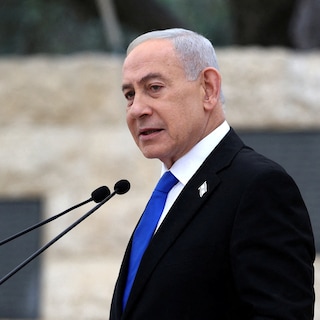
Netanyahu: Israel Must Eventually Move Beyond US Military Aid
Translated from Dutch, summarized and contextualized by DistantNews.
At a glance
News
Named sources
Context piece
- Israeli Prime Minister Benjamin Netanyahu stated that Israel will eventually need to transition away from relying on US military aid.
- The statement suggests a long-term strategic shift in Israel's defense posture.
- The article does not provide further details on the timeline or the specific reasons behind this potential transition.
Prime Minister Benjamin Netanyahu's recent assertion that Israel must eventually wean itself off American military aid signals a significant, albeit long-term, strategic consideration for the Jewish state. While the precise timing and the underlying motivations for this statement remain subjects of discussion, it points towards a future where Israel aims for greater self-sufficiency in its defense capabilities.
For decades, US military assistance has been a cornerstone of Israel's security, enabling it to maintain its qualitative military edge in a volatile region. This aid package is not merely financial; it encompasses advanced weaponry, intelligence sharing, and joint military exercises, all of which are critical to Israel's defense strategy.
Netanyahu's statement, as reported by De Volkskrant, could be interpreted in several ways. It might reflect a growing confidence in Israel's indigenous defense industry and technological prowess. Alternatively, it could be a strategic message aimed at both domestic and international audiences, emphasizing Israel's resilience and its commitment to long-term security independence. Regardless of the immediate implications, the sentiment suggests a forward-looking approach to national security, preparing for a future where regional dynamics and international alliances may evolve.
DistantNews Editorial
Originally published by De Volkskrant in Dutch. Translated, summarized, and contextualized by our editorial team with added local perspective. Read our editorial standards.
More Stories
/s3/static.nrc.nl/wp-content/uploads/2026/05/22142051/220526VER_2033937707_jetten.jpg)
From Our Blog

What Gets Lost (and Found) When News Is Translated

The Critical Role of Diaspora Media in Global News

What Travellers Should Know About Countries with Restricted Press

A Digital Nomad's Guide to Following Local News

How the Same Story Looks Different in Different Countries
