


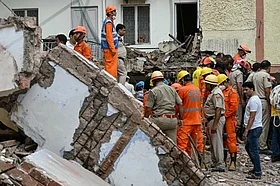

‘Never faced this before’: Australian expert calls Nepal rescue an ‘unprecedented’ challenge
Translated from English and summarized by DistantNews. Read the original for the full story.
At a glance
News
Named sources
Ongoing story
- Australian rescue expert Arnold Dix described multiple searches in Himalayan hydropower tunnels as an unprecedented challenge.
- The August 26 glacial and mountain collapse on the China-Nepal border killed at least 1,385 people and left more than 5,500 missing across the two countries.
- Rescue teams continue ground, air and tunnel operations after three workers were pulled alive from tunnels.
“We are facing something I have never faced before,” Australian rescue expert Arnold Dix said as teams continued searching Himalayan hydropower tunnels in Nepal.
We are facing something I have never faced before.
The rescue effort follows the August 26 collapse of glaciers and mountains on the China-Nepal border. At least 1,385 people have died, while more than 5,500 remain missing across the two countries. Hundreds of hydropower workers are among those unaccounted for, and the rescue operation has entered its thirteenth day.
Dix, president of the International Tunnelling and Underground Space Association, said the challenge involved several possible rescues unfolding at once. “Not one rescue, but multiple potential rescues, unfolding at the same time, in different places, each with its own dangers, uncertainties, and lives that may still be saved,” he said in a social-media post.
Not one rescue, but multiple potential rescues, unfolding at the same time, in different places, each with its own dangers, uncertainties, and lives that may still be saved.
Nepal observed a national day of mourning on Monday in line with traditional Hindu rituals, but rescue operations continued. Nepal Army spokesman Raja Ram Basnet said teams were working “with the same tempo we had on day one.” Their focus, he said, was on searches “on the ground, by air, and in the tunnels” to ensure that nobody remained stranded.
Our focus is on search and rescue at three levels, on the ground, by air, and in the tunnels. We are making sure that no one is still stranded.
The rescue of three workers from deep inside tunnels, including two Nepalis on Friday and a Chinese worker on Saturday, raised hopes that more survivors could be found. Foreign experts from China, India and South Korea are assisting Nepali teams, including Dix, who advised rescuers during India’s 2023 operation to free 41 men trapped for 17 days inside the collapsed Silkyara tunnel in Uttarakhand. “Silkyara taught me never to confuse unlikely with impossible,” Dix said.
We are measured not only by the lives we save, but by the lives we refuse to abandon.
About this summary
Originally published by Khaleej Times in English. Translated, summarized, and contextualized automatically by DistantNews, with a note on how the source frames the story. Not individually reviewed before publishing. How this works.
More Stories

From Our Blog

News in Translation: What Gets Lost, and How We Keep the Framing

Diaspora Media: How Communities Follow News From Home

Traveling Where the Press Is Not Free: How to Read the News There

The Digital Nomad's Guide to Local News

The Same Story, Different Countries: How Coverage Changes at the Border
