

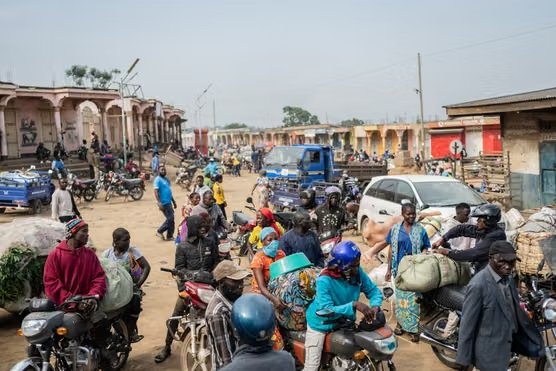
New deadly ADF attack in DRC: How to stop the spiral of violence in Congo
Translated from French, summarized and contextualized by DistantNews.
At a glance
News
Sources not specified
Ongoing story
- At least thirteen civilians were killed in a new attack attributed to the Allied Democratic Forces (ADF) in the Ituri province of the Democratic Republic of Congo.
- The attack, which saw a village set ablaze, highlights the persistent violence in eastern DRC despite ongoing joint military operations with Uganda.
- Critics accuse President Felix Tshisekedi's administration of prioritizing political calculations over security, while civil society and the opposition call for dialogue to achieve lasting peace.
Eastern Democratic Republic of Congo remains gripped by violence following a fresh massacre in Ituri province, attributed to the Ugandan-origin Allied Democratic Forces (ADF), a group affiliated with the Islamic State. Local authorities reported that at least thirteen civilians were killed and an entire village was burned during a nighttime incursion.
This latest atrocity is part of a long series of abuses by the militia against rural populations in the region, where armed violence is endemic despite the presence of national military forces. The recurring attacks underscore the persistent obstacle to lasting peace in eastern DRC. Since late 2021, the Congolese Armed Forces (FARDC) have been engaged in a joint operation with the Ugandan People's Defence Force (UPDF) named Shujaa, aimed at dismantling ADF strongholds in North Kivu and Ituri.
Nearly four years into the operation, its success remains contested. While several rebel bases have been destroyed, ADF fighters have reportedly dispersed into mobile cells, intensifying attacks on isolated villages rather than confronting military columns. In response to the ongoing tragedy, civil society and the opposition are denouncing the authorities' inability to protect civilians, despite significant resources deployed.
President Felix Tshisekedi faces particular criticism from detractors who accuse him of prioritizing power consolidation and political maneuvering, such as pursuing a third term, over managing the severe security crisis in the east. The question arises: how can the spiral of violence be stopped and peace restored in a country where trust between the government and opposition appears irrevocably broken?
The opposition, grouped within the C64 platform, advocates for an inclusive national dialogue, urging its convocation before August 15, 2026. They argue that military solutions alone are unlikely to achieve lasting peace. Meanwhile, families in eastern DRC are fleeing their homes, their lives precarious, with fathers losing jobs and mothers gathering children to escape the violence.
DistantNews Editorial
Originally published by Le Pays in French. Translated, summarized, and contextualized by our editorial team with added local perspective. Read our editorial standards.
More Stories
From Our Blog

What Gets Lost (and Found) When News Is Translated

The Critical Role of Diaspora Media in Global News

What Travellers Should Know About Countries with Restricted Press

A Digital Nomad's Guide to Following Local News

How the Same Story Looks Different in Different Countries
