

🇵🇦
Panama
New fossil species of batfish discovered in Panama
Translated from Spanish, summarized and contextualized by DistantNews.
At a glance
News
Sources not specified
Context piece
- Researchers discovered a new fossil species of batfish in Panama, named Dactylopterus decrozi.
- The fossil provides insights into how the formation of the Isthmus of Panama influenced marine evolution.
- The study suggests the divergence of Pacific and Atlantic lineages occurred about 10 million years ago due to the isthmus's closure.
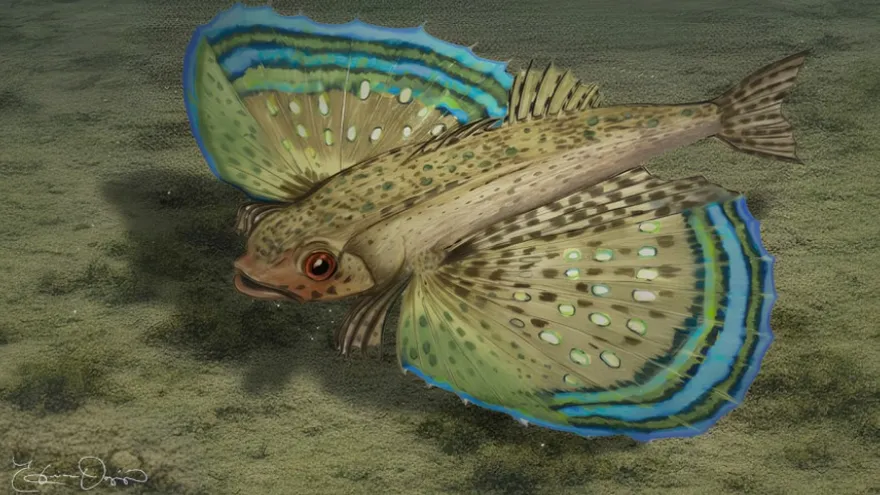
A newly discovered fossil species of batfish, Dactylopterus decrozi, unearthed in Panama, is shedding light on the profound impact of the Isthmus of Panama's formation on marine evolution. Researchers from the University of Panama participated in the identification of this exceptionally preserved fossil, which represents the head of a fish belonging to the Dactylopteridae family. The findings were recently published in the international scientific journal Scientific Reports.
The finding was identified as Dactylopterus decrozi and its results were recently published in Scientific Reports, an international scientific journal.
Using advanced techniques like computed tomography scans performed at the Federal University of Rio de Janeiro's Nuclear Instrumentation Laboratory, scientists confirmed that the specimen represented a species previously unknown to science. The fossil was found in the Chagres Formation, a geological layer that holds clues to the region's ancient past.
The study connects the presence of Dactylopterus in the Chagres Formation with molecular clock data, offering compelling evidence for the evolutionary history of this fish group and its relationship to the isthmus's geological development. The research indicates that the split between Pacific and Atlantic lineages occurred approximately 10 million years ago, a period coinciding with the closure of the Central American Seaway.
The presence of Dactylopterus in the Chagres Formation, combined with molecular clock studies, provides evidence about the evolutionary history of this group and its relationship to the formation of the isthmus.
Investigators propose that an ancestral lineage migrated from the Pacific to the Atlantic through deep-water channels linked by the seaway during the isthmus's formation. The subsequent closure of these deep-water connections isolated populations, fostering the evolution of the Dactylopterus genus in the Atlantic. This evolutionary process, known as vicariance, occurs when geological changes create barriers that separate related populations, leading to differentiation and speciation.
This evolutionary process, known as vicariance, occurs when a geological change creates a barrier that separates populations of the same lineage, creating conditions for their differentiation and speciation.
The research marks the first evidence linking the influence of the Central American Seaway to marine fauna speciation events around 10 million years ago. The team also analyzed the rock containing the fossil using X-ray spectroscopy and diffractometry at the Fluminense Federal University in Brazil. The presence of andesine and pyrite suggested the specimen was buried near its death site in a deep marine environment with low oxygen levels. The species name, Dactylopterus decrozi, honors the late marine biologist Luis D'Croz, a professor at the University of Panama and former president of the Panamanian Association for the Advancement of Science, who mentored many Panamanian marine biologists.
The name Dactylopterus decrozi pays posthumous tribute to marine biologist Luis D'Croz, a professor at the University of Panama and former president of the Panamanian Association for the Advancement of Science, who contributed to the training of several generations of Panamanian marine biologists.
DistantNews Editorial
Originally published by TVN Panamá in Spanish. Translated, summarized, and contextualized by our editorial team with added local perspective. Read our editorial standards.
More Stories



From Our Blog

What Gets Lost (and Found) When News Is Translated

The Critical Role of Diaspora Media in Global News

What Travellers Should Know About Countries with Restricted Press

A Digital Nomad's Guide to Following Local News

How the Same Story Looks Different in Different Countries
